
Blog
K pneumoniae: Introduction, Classification, Pathogenicity, Laboratory Diagnosis and Treatment
 Introduction of K pneumoniae Klebsiella is from the surname of German-Swiss microbiologist Edwin Klebs (1834–1913). Klebsiella is a genus of Gram-negative, oxidase-negative, fimbriated, non -motile, non-sporing rod-shaped bacteria with a prominent polysaccharide-based capsule and having size o,f 0.5 -0.8 µm wide to 1 -2 µm. They are found everywhere in nature and also in bacterial flora in our intestines. K pneumoniae scientific classification is as follows Domain: Bacteria Phylum: Proteobacteria Class: Gammaproteobacteria Order: Enterobacterales Family: Enterobacteriaceae Genus: Klebsiella Species: pneumoniae Subspecies...
Oxidase Test: Introduction, Principle, Test Requirements, Procedure, Result Interpretation and Keynotes
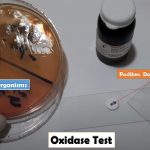 Introduction of Oxidase Test (Kovac’s Method) Oxidase test negative and positive as shown above picture. Gordon and McLeod introduced the use of a dimethyl-phenylenediamine dihydrochloride solution to test for the presence of oxidase systems in 1928. In particular, they used the test to distinguish N. gonorrhoeae (oxidase test positive) from Staphylococcus species and Streptococcus species (oxidase negative). The sensitivity of the oxidase test was increased when Kovács found that a tetramethyl-p-phenylenediamine dihydrochloride solution gave a quicker reaction. Gaby and Hadley developed a...
CAMP Reaction: Introduction, Principle, Test Requirements, Test Procedure, Result and Interpretation and Keynotes
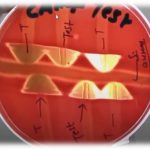 CAMP Reaction The CAMP reaction or test is applied to the presumptive identification of Streptococcus agalactiae. It was first described in 1944 by Christie, Atkins, and Munch-Petersen, and the CAMP test is an acronym of their names. Principle of CAMP Reaction The beta lysin produced by Staphylococcus aureus is sphingomyelinase in nature, which acts on the sphingomyelin present on the cell membrane of sheep red blood cells. This results in the formation of ceramide which is cleared by...