
Blog
Urease Test: Principle, Procedure, Interpretation, Urease Positive Organisms, Keynotes and Limitations
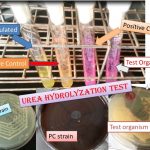 Introduction of Urease Test / Urea hydrolization Test / Urea Test The urease test is important for certain bacteria and fungi that possess the enzyme urease that hydrolyzes urea releasing ammonia into the medium. This produces a change in the pH of the medium that can be detected by the color change in the indicator dye. This test can be used to differentiate different groups of bacteria and fungi. Principle of Urease Test This test is...
Citrate Utilization Test: Principle, Procedure, Result and Interpretation, Citrate Utilization Test Positive Bacteria and keynotes
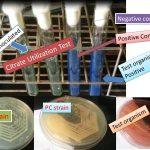 Principle of Citrate Utilization Test A citrate utilization test is used to determine the ability of an organism to utilize sodium citrate as its only carbon source and inorganic ammonium salts as its only nitrogen source. When the bacteria metabolize citrate, the ammonium salts are broken down to ammonia, which increases alkalinity turning the bromthymol blue indicator from green to blue. [caption id="attachment_972" align="alignnone" width="876"] Principle of Citrate Utilization Test[/caption] Requirements for test Simmons citrate agar slant...
Oxidase Test: Principle, Procedure, Result Interpretation and Various Oxidase Positive Organisms
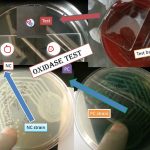 Introduction of Oxidase Test (Kovac's Method) Gordon and McLeod introduced the use of a dimethyl-phenylenediamine dihydrochloride solution to test for the presence of oxidase systems in 1928 . In particular, they used the test to distinguish N. gonorrhoeae (oxidase test positive) from Staphylococcus species and Streptococcus species (oxidase negative). The sensitivity of the oxidase test was increased when Kovác's found that a tetra-methyl-p-phenylenediamine dihydrochloride solution gave a quicker reaction. Gaby and Hadley developed a modified oxidase...