
Blog
Dermatophyte: Introduction, lab diagnosis and treatment
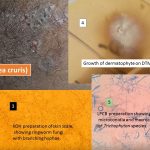 Dermatophyte: Introduction, lab diagnosis and treatment Dermatophyte Dermatophyte is a pathogenic fungus that grows on skin, mucous membranes, hair, nails, and other body surfaces, causing ringworm and related diseases.. It is a group of three genera Trichophyton, Microsporum and Epidermophyton. It causes infection called ringworm. Clinically ringworm is of following types depending on the site of body involved. Tinea axillaries (axilla),tinea barbae(beard area),tinea corporis(non-hair skin),tinea capitis( hanir and scalp),tinea cruris(groin),tinea pedis(foot).The most common ringworm in human...
Formal gel test for Visceral leishmaniasis: Introduction, principle, procedure and result interpretation
 Introduction of formal gel test for visceral leishmaniasis Visceral leishmaniasis or Kala-Azar is a disease caused by Leishmania donovani. The disease has following features like remittent type of fever, massive enlargement of the spleen and generalized weakness. It is fatal if untreated within 2 years. Formal gel test is also called Napier's aldehyde test. It is a non specific test. Specimen for formal gel test for visceral leishmaniasis serum Method Chemical: Formal gel test Principle of formal gel...
Charcot Leyden crystal : Introduction, Detection and Its Clinical Significance
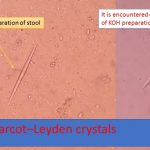 Introduction of Charcot Leyden crystal Charcot Leyden crystal is from surnames of describers Jean-Martin Charcot and Ernst Viktor von Leyden. It composes of an eosinophilic lysophospholipase binding protein called Galectin -10. It is a microscopic crystal and observable under microscope in specimens like stool, sputum and pleural fluid of people who are in allergic and parasitic diseases. Charcot–Leyden crystal appearance It varies in size and may be up to 50 µm. It is slender and pointed at both...