
Blog
Antimicrobial Susceptibility Testing (AST): Introduction, Methods, Procedure and Result Interpretation
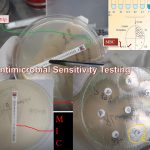 Antimicrobial Susceptibility Testing (AST) Antimicrobial Susceptibility Testing (AST) is a laboratory method for determining the susceptibility of organisms to therapy with antibiotics. Antimicrobial Susceptibility Testing (AST) is usually carried out to determine which antibiotic / antimicrobial agent will be most successful in treating a microbial infection in vivo. Antimicrobial Susceptibility Testing Methods Disc diffusion method e.g. Kirby-Bauer and Stokes method Dilution method Tube dilution Agar dilution Disc diffusion and Dilution method e.g. Epsilometer Test or E-Test Preparation of the inoculum The routinely used method...
Acridine Orange Staining: Introduction, Principle, Procedure, Result Interpretation and Uses
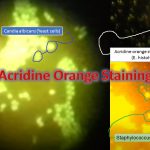 Introduction of Acridine Orange Staining Acridine orange is a fluorochrome stain. Acridine orange staining uses the rapid identification of Trichomonas vaginalis, yeast cells, and clue cells in vaginal smears. It can also use to detect intracellular gonococci, meningococci, and other bacteria, particularly in blood cultures. It intercalates with the nucleic acid i.e. either DNA or RNA present in organisms and fluoresces to emit various colors that help in differentiation. This binding is the result of the electrostatic interactions of acridine molecules between...
Auramine-Phenol Fluorochrome Staining: Introduction, Principle, Procedure, Result Interpretation and Limitations
 Introduction of Auramine -Phenol stain Auramine-Phenol is a fluorochrome stain and used to visualize acid-fast structures of various microorganisms especially Mycobacterium tuberculosis and in modified form for Mycobacterium leprae, Nocardia species, Cryptosporidium parvum, Cyclospora cayetanensis , Isospora belli, and fungal spores. Ziehl-Neelsen (hot), Kinyoun (cold) are still widely used methods to detect acid-fast structures in these organisms in developing countries but sensitivity is high of fluorochrome stain. The acid fastness of Mycobacterium tuberculosis is due to having a thick cell wall composed...