
Fungal Reagent and Stains: Introduction, List and Their Uses
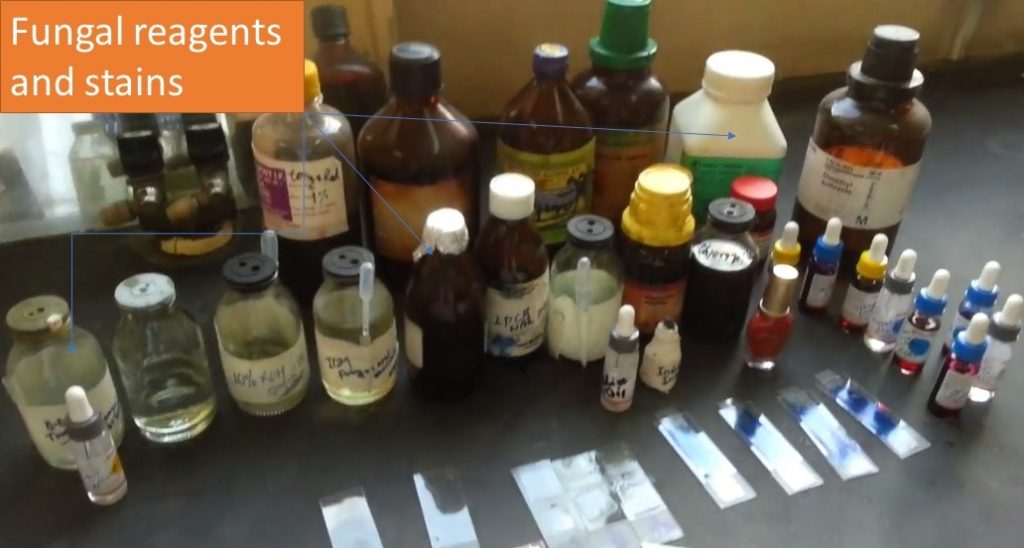
Introduction of Fungal reagents and stains
Fungal reagents and stains are necessary for the isolation and identification of various fungi that cause a variety of fungal diseases. This makes it easier to treat such types of diseases. The most common fungal reagent and stains are as follows.
List of fungal reagent and stains
- 20% potassium hydroxide (KOH) is very useful for the presumptive identification of fungal diseases.
- KOH with DMSO (Dimethyl Sulfoxide) is a modification of KOH wet mount preparation. DMSO is an organic solvent. This makes it easier to use KOH reagent from cumbersome steps like heating or waiting for a longer duration to clear the specimen making fungal elements more visible during direct microscopic examination. Therefore the addition of DMSO to the KOH reagent enables specimens to be examined immediately or after only a few minutes.
- KOH- calcofluor mount
- Negative stain: India ink or nigrosin is useful for observation of Cryptococcus neoformans capsule.
- Giemsa stain for Histoplasma capsulatum
- Yeast colony examination with 0.05% Tween 8 wetting agent- reduce bubble formation and prevent infections
- LPCB (Lactophenol Cotton Blue) solution: It is an excellent stain for examination of fungal elements that stains chitin and cellulose of fungi.
- Gram stain: Fungal elements are Gram-positive.
- Olive oil is used for Malassezia species.
- 95% ethanol
- Nail polish
- Gomori methenamine silver stain
- Mucicarmine stain
- Periodic acid Schiff (PAS) stain
- Sulfation reagent and Toluidine blue O (TBO) stain is used for cyst of Pneumocystis jirovecii.
- Modified Ziehl-Neelsen stain for fungal staining i.e. 0.25% sulphuric acid as a decolorizing agent
- Acridine orange
- PHOL stain same as LPCB but phenol and cotton blue is replaced by formalin and methylene blue. PHOL stands for Pal, Hasegawa, ono, and Lee from the surname of researchers.
- KOH with chlorazol black E for Prototheca species.
- Congo red
- IOM fungal wet mount
- 20% KOH- 20 gm
- 40% DMSO4-40 ml
- 10% glycerol -10 ml
- 0.05% Tween 80-0.05 ml
It is stable at room temperature for up to 2 years.
Notes
- Glycerol: Hygroscopic agent. It Prevents drying.
- Tween 80 wetting agents and reduce bubble formation also prevent infection and conidia from escaping.
- Cotton blue: stains the fungal elements
- Phenol: It acts as a disinfectant.
- Lactic acid: It helps in preserving the morphology of the fungal element.
Avoid No 21 because of under research…
Further Reading for fungal reagent and stains
- Medical Mycology. Editors: Emmons and Binford, 2nd ed 1970, Publisher Lea and Febiger, Philadelphia.
- Rippon’s JW: Medical Microbiology. The pathogenic fungi and the Pathogenic Actinomycetes. 3rd ed 1988 Publisher WB Saunder co, Philadelphia.
- Clinical Microbiology Procedure Handbook Vol. I & II, Chief in editor H.D. Isenberg, Albert Einstein College of Medicine, New York, Publisher ASM (American Society for Microbiology), Washington DC.
- A Text-Book of Medical Mycology. Editor: Jagdish Chander. Publication Mehata, India.
- Practical Laboratory Mycology. Editors: Koneman E.W. and G.D. Roberts, 3rd ed 1985, Publisher Williams and Wilkins, Baltimore.
- Description of Medical Fungi-David Ellis, Stephen Davis, Helen Alexiou, Rosemary Handke, Robyn Bartley
[4853 visitors]