
Trichosporon species: Introduction, Morphology, Medically Important Species, Pathogenicity, Lab Diagnosis, Treatment, Prevention, and Keynotes
Introduction
Trichosporon is a genus of anamorphic, yeast-like basidiomycetous fungi widely distributed in nature, particularly in tropical and temperate regions. First identified by Beigel in 1865, it commonly exists as a saprophytic organism in soil, water, plants, and animal droppings. In humans, it is a normal commensal of the skin, respiratory tract, oral cavity, and gastrointestinal tract. Historically, clinical isolates were grouped under the umbrella term Trichosporon beigelii (or T. cutaneum). Modern molecular taxonomy has split the genus into more than 50 distinct species. It is now recognized as a critical emerging opportunistic pathogen capable of causing severe, life-threatening invasive infections (trichosporonosis) in immunocompromised hosts.
Morphology
Macromorphology (Colony Characteristics)
- Media: Grows rapidly on standard fungal media like Sabouraud Dextrose Agar (SDA) at 25°C to 37°C.
- Appearance: Initially white to cream-colored, smooth, moist, and waxy.
- Maturation: Becomes dry, yellowish, wrinkly, and develops a distinct cerebriform (brain-like) appearance with radial furrows and irregular folds.
Micromorphology (Microscopic Features)
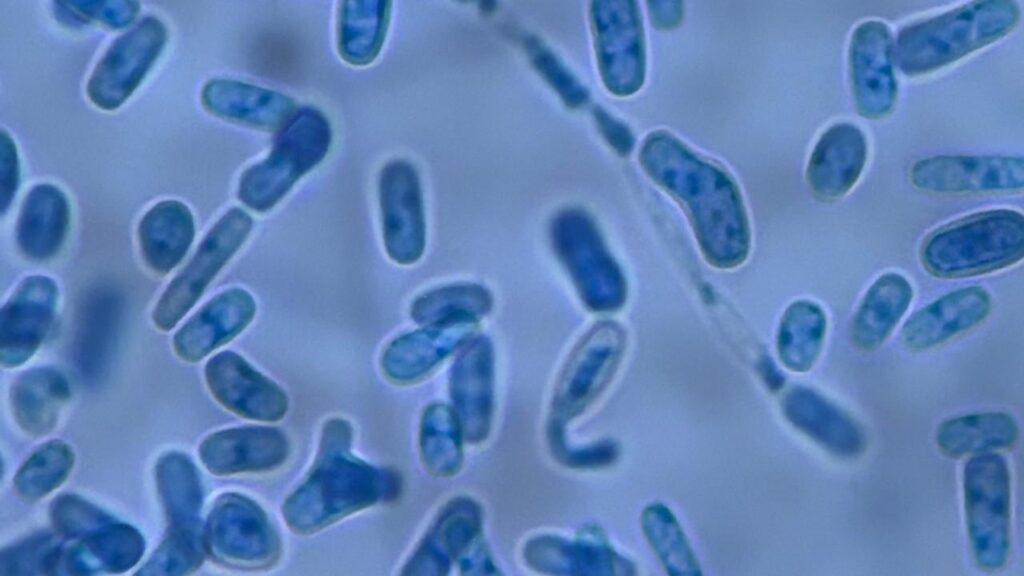
- True Hyphae & Pseudohyphae: Well-developed, hyaline, and septate.
- Arthroconidia: Distinctive rectangular or barrel-shaped cells formed by the fragmentation of hyphae. This is the most defining diagnostic trait of the genus.
- Blastoconidia: Budding yeast cells arising singly or in short chains along the hyphae or pseudohyphae.
Medically Important Species
The historical designation Trichosporon beigelii was abandoned in 1992. The genus is now taxonomically divided, and six primary species are responsible for human infections:
| Species | Primary Clinical Association |
| Trichosporon asahii | The most common cause of invasive, disseminated trichosporonosis. |
| Trichosporon mucoides | Associated with both systemic/deep-seated infections and superficial lesions. |
| Trichosporon inkin | Chiefly responsible for pubic/genital white piedra. |
| Trichosporon ovoides | Chiefly responsible for white piedra of the scalp hair. |
| Trichosporon asteroides | Primarily causes superficial skin infections; rarely causes invasive disease. |
| Trichosporon cutaneum | Associated with superficial cutaneous mycoses, onychomycosis, and interdigital lesions. |
Pathogenicity & Clinical Manifestations
Trichosporon species are low-virulence saprophytes that transition into pathogens via specific virulence factors, including biofilm formation on medical devices, extracellular protease/lipase production, and glucuronoxylomannan (GXM) in their cell walls.
- Superficial Trichosporonosis
- White Piedra: Characterized by soft, white, yellowish, or green nodules loosely attached to the hair shafts of the scalp, beard, or pubic region. It weakens the hair shaft but does not destroy the follicle.
- Cutaneous Infections: Onychomycosis (nail infections), interdigital scaling, and skin lesions resembling ringworm.
- Deep/Invasive Trichosporonosis
- At-Risk Patients: Profoundly neutropenic cancer patients (especially those with hematological malignancies), organ transplant recipients, and ICU patients with indwelling central venous catheters.
- Fungemia & Dissemination: The fungus enters the bloodstream, rapidly spreading to multiple organs. It presents with fever, purpuric skin lesions (maculopapular nodules), renal failure, and pulmonary infiltrates. Mortality rates are high, often exceeding 40-50%.
Laboratory Diagnosis
Direct Microscopy
- Specimens: Hair shafts (for white piedra), skin/nail scrapings, blood, urine, or cerebrospinal fluid (CSF).
- Methods: Potassium hydroxide (KOH) mounts, Gram stain, or Calcofluor white staining.
- Observation: Reveals hyaline septate hyphae fragmenting into arthroconidia, alongside budding blastoconidia.
Culture
- Samples are inoculated onto Sabouraud Dextrose Agar (SDA) without cycloheximide (which inhibits Trichosporon).
- Subcultures on rice agar are used to stimulate the optimal production of arthroconidia and blastoconidia for clear microscopic distinction.
Biochemical & Serological Tests
- Urease Test: Strong Urease-positive (differentiates it from Candida species).
- Carbon Assimilation: Evaluated using commercial systems like API 20C AUX, though it only reliably identifies T. asahii, T. inkin, and T. mucoides.
- Cryptococcal Antigen Test: Cross-reacts with the Cryptococcus neoformans latex agglutination test due to shared cell wall glucuronoxylomannan. A false-positive cryptococcal test in a neutropenic patient can be a major clue for systemic Trichosporon.
Molecular Methods
- Gold Standard: DNA sequencing targeting the Internal Transcribed Spacer (ITS) or Intergenic Spacer 1 (IGS1) regions is necessary for accurate, definitive species-level identification.
Treatment
- Superficial Infection: Easily managed by shaving the affected hair and applying topical azole creams (ketoconazole, clotrimazole).
- Invasive Infection:
- Drug of Choice: Voriconazole is the absolute first-line therapy. It demonstrates excellent in vitro activity and clinical efficacy.
- Amphotericin B: Shows variable and often very high Minimal Inhibitory Concentrations (MICs), leading to a high rate of clinical failure.
- Echinocandins: Trichosporon species possess intrinsic resistance to echinocandins (caspofungin, micafungin). These drugs must never be used.
- Source Control: Immediate removal of any indwelling central venous or urinary catheters is vital, as the fungus forms thick biofilms on synthetic materials.
Prevention
- Catheter Care: Strict aseptic protocols for central line insertion and maintenance.
- Fungal Prophylaxis Surveillance: Vigilance in hematology wards, as widespread use of echinocandins can select for breakthrough Trichosporon infections.
- Hygiene: Proper bodily hygiene and keeping skin dry to prevent superficial multiplication.
Keynotes
- Basidiomycete Yeast: Unlike Candida (an ascomycete), Trichosporon belongs to the phylum Basidiomycota.
- Morphological Triad: Characterized by the concurrent presence of true hyphae, pseudohyphae, budding blastoconidia, and rectangular arthroconidia.
- Urease Positive: Differentiates it from Candida.
- Cryptococcal Cross-reactivity: Can cause false-positive serum cryptococcal antigen tests.
- Echinocandin Resistance: Intrinsically resistant to echinocandins; Voriconazole is the premier drug of choice.
Further Readings
- https://www.elsevier.es/en-revista-medicina-universitaria-304-articulo-trichosporon-spp-an-emerging-fungal-X1665579614283703?utm_medium=email&utm_source=transaction
- https://www.sciencedirect.com/topics/immunology-and-microbiology/trichosporon-asahii
- https://www.mdpi.com/2309-608X/12/3/167
- https://www.ncbi.nlm.nih.gov/books/NBK482477/
- https://www.sciencedirect.com/topics/biochemistry-genetics-and-molecular-biology/trichosporon
- https://mycology.adelaide.edu.au/fungal-descriptions-and-antifungal-susceptibility/yeast-like-fungi/trichosporon
- https://pdfs.semanticscholar.org/56c7/18223fff2fbdf11c736fe8c98359a7d5a63a.pdf
- https://journals.asm.org/doi/abs/10.1128/cmr.00003-11
- https://www.sciencedirect.com/topics/immunology-and-microbiology/trichosporon
- https://www.ncbi.nlm.nih.gov/sites/books/NBK482477/
- https://www.mospbs.com/uploads/assets/article/pdfs/3724119428022019.pdf
- https://emedicine.medscape.com/article/230705-overview
- https://www.sciencedirect.com/science/article/pii/S1749461324000149
- https://drfungus.org/knowledge-base/trichosporon-species/
- https://pmc.ncbi.nlm.nih.gov/articles/PMC3194827/
- https://pmc.ncbi.nlm.nih.gov/articles/PMC4861564/
- https://pmc.ncbi.nlm.nih.gov/articles/PMC5383668/
- https://onlinelibrary.wiley.com/doi/full/10.1111/j.1439-0507.2004.01062.x