
Niger Seed Agar: Introduction, Principle, Composition, Test Procedure, Colony Morphology and Uses
Introduction of Niger Seed Agar
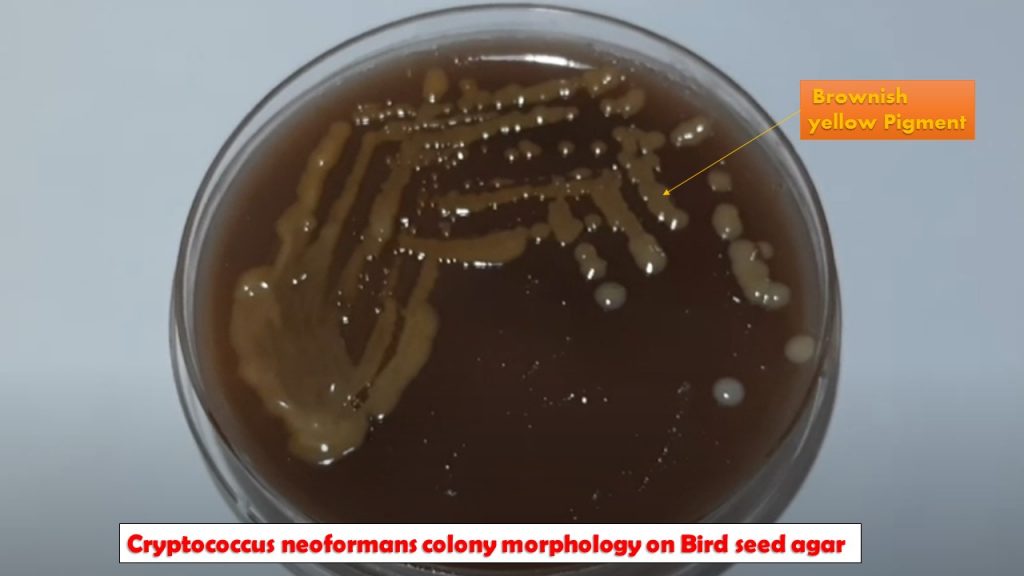
BSA stands for Bird Seed Agar which sounds seed of a bird but actually, it is a niger seed, botanical name Guizotia abyssinica. Niger seed contains caffeic acid that serves as a substrate for the detection of phenoloxidase, an enzyme produced by Cryptococcus neoformans. The action of phenoloxidase on caffeic acid results in the production of melanin which is occupied by the yeast cell wall forming brownish-yellow. Bird seed agar is thus also called niger seed agar. Stab’s formulation BSA is a selective and differential medium for both C. neoformans and C. gattii while modification of Staib’s formulation ignores C. gattii.
Principle of Niger Seed Agar
Niger seeds, creatinine, and glucose provide nutrients for the growth of Cryptococcus neoformans. Chloramphenicol inhibits the bacteria as well as rapidly growing molds that often overgrow the slow-growing dimorphic fungi. The addition of diphenyl also assists in preventing the growth of molds and fungus and is therefore used as a selective agent in the medium.
Composition of Niger Seed Agar
Ingredients Gms / Litre
- Guizotia abyssinica (niger) seeds: 70.000
- Creatinine: 0.78
- Dextrose (Glucose): 10.0
- Chloramphenicol: 0.05
- Agar: 20.0
- Distilled water: 1000 mL
- Final pH ( at 25°C): 6.7±0.2
Preparation of Niger Seed Agar
- Suspend 10.8 grams Bird Seed Agar ( BSA) in 99 mL purified/distilled or deionized water.
- Heat to boiling to dissolve the medium completely.
- Sterilize by autoclaving at 15 lbs pressure (121°C) for 15 minutes.
- After autoclaving, leave for cooling to 45-50°C and add 100 µg diphenyl per ml of medium (1 ml of sterile 1% w/v aqueous solution of diphenyl).
- Mix well before dispensing.
- Pour BSA into each plate and leave plates on the sterile surface until the agar has solidified.
- Store the plates in a refrigerator at 2-8°C.
Storage and Shelf life
- Store at 2-8ºC and away from direct light.
- Media should not be used if there are any signs of deterioration (shrinking, cracking, or discoloration), contamination.
- The product is light and temperature-sensitive; protects from light, excessive heat, moisture, and freezing.
Test Requirements
- Test specimens ( Clinical samples-Cerebrospinal Fluid (CSF), tissue, exudates, sputum, blood, and urine or fungal growth)
- Inoculating loop
- Bunsen burner
- Incubator
- Control strains ( Cryptococcus neoformans ATCC 32045
and Candida albicans ATCC 10231)
Test Procedure (specimen/organism inoculation)
- Allow the plates to warm at 37°C or to room temperature, and the agar surface to dry before inoculating.
- Take a plate for one specimen.
- Inoculate and streak the specimen as soon as possible after collection.
- If the specimen to be cultured is on a swab, roll the swab over a small area of the agar surface.
- Streak for isolation with a sterile loop.
- Incubate the plate aerobically at 30°C for 7 days.
- Examine colony characteristics.
Colony Morphology of Niger Seed Agar
Development of brownish yellow-pigmented smooth colonies-Cryptococcus neoformans
Non-pigmented colonies-Cryptococcus laurentii, Candida, Saccharomyces cerevisiae
Uses of Niger Seed Agar
Niger Seed Agar is the recommended medium for selective isolation and differentiation of Cryptococcus neoformans from other Cryptococcus and other yeasts.
Keynotes on BSA
- Staib’s Medium (Bird Seed Agar) is formulated for selective isolation and differentiation of C.neoformans and C. gattii. from other Cryptococcus species and other yeasts.
- The above medium is formulated by Staib and Shields and Ajello which is selective isolation and differentiation of only C. neoformans from other Cryptococcus species and other yeasts.
- On the above footage, Cryptococcus neoformans grew on BSA after 5 days of incubation at room temperature ( 30°C).
- Compositiuon of Staib Formunation
Ingredients Gms/Litre
- Guizotia abyssinica (niger seed): 50.0
- Dextrose (glucose): 1.0
- KH2PO4 (potassium dihydrogen orthophosphate): 1.0
- Creatinin: 1.0
- Agar: 15.0
- Final pH: 6.5 +/- 0.3 at 25ºC.
Additives: to each 500 ml bottle
- Penicillin G (20 units/ml) 1 mL
- Gentamicin (40 mg/ml) 1 mL
- Other species of Cryptococcus are-
- C. albidus ( nitrate positive)
- C. laurentii ( melibiose fermentation)
- C. gattii ( Trehalose positive)
- C. neoformans: All the above tests are negative.
- C. neoformans var. grubii ( serptype A)- worldwide distribution
- C. neoformans var. neoformans (serotype D)-Restricted distribution and prevalent in France, Italy, and Denmark.
- Diphenyl prevents the growth of molds and fungus and is therefore used as a selective agent in the medium.
- Bird seed agar is also known as Caffeic acid agar or niger seed agar or Staib agar.
Further Readings
- https://www.himedialabs.com/TD/M675.pdf
- http://www.essentialpaservices.com/listing/birdseed-agar-thermo-fisher-scientific-425b-ce549f
- https://catalog.hardydiagnostics.com/cp_prod/product/g213-caffeic-acid-agar-bird-seed-agar-for-cryptococcus-15x100mm-plate-order-by-the-package-of-10-by-hardy-diagnosticsbr-bminimum-order-10-packsb-media-prepared
- https://en.wikipedia.org/wiki/Biphenyl
- Casadevall A, Perfect J. R., 1998, Cryptococcus neoformans, ASM Press, Washington, D.C.
- A Text-Book of Medical Mycology. Editor: Jagdish Chander. Publication Mehata, India.
- Clinical Microbiology Procedure Handbook, Chief in editor H.D. Isenberg, Albert Einstein College of Medicine, New York, Publisher ASM (American Society for Microbiology), Washington DC
- Description of Medical Fungi-David Ellis, Stephen Davis, Helen Alexiou, Rosemary Handke, Robyn Bartley