
Formal gel test for Visceral leishmaniasis: Introduction, principle, procedure and result interpretation
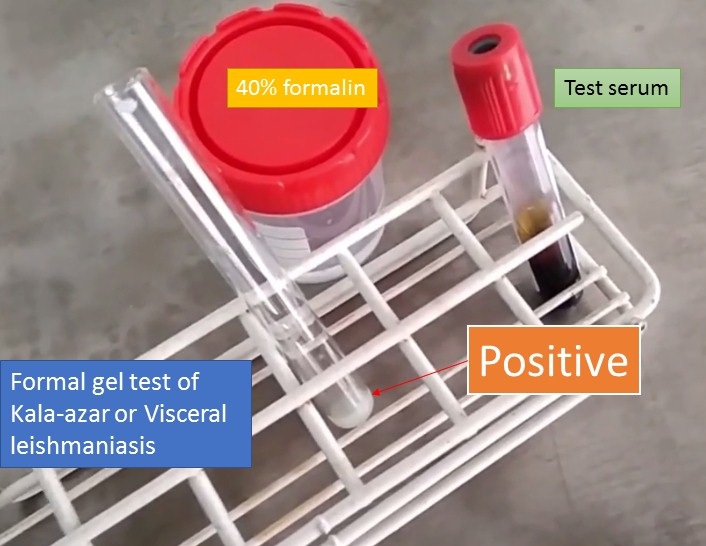
Introduction of formal gel test for visceral leishmaniasis
Visceral leishmaniasis or Kala-Azar is a disease caused by Leishmania donovani. The disease has following features like remittent type of fever, massive enlargement of the spleen and generalized weakness. It is fatal if untreated within 2 years. Formal gel test is also called Napier’s aldehyde test. It is a non specific test.
Specimen for formal gel test for visceral leishmaniasis
serum
Method
Chemical: Formal gel test
Principle of formal gel test for visceral leishmaniasis
Gamma globulin increases in visceral leishmaniasis. It forms a solid gel with formalin.
Requirements for Formal gel test
Test tube (100 X 10 mm)
Formalin, 40% (v/v)
Dropper
Test specimen
Procedure of formal gel test for visceral leishmaniasis
- Add 0.5 ml (10 drops) of serum in a test tube.
- Add 0.5 ml (10 drops) formalin.
- Observe the reaction after 10 minutes.
- As a control, use normal serum and perform the test.
Observations
Development of white color gel within 20 minutes achieved in test where as lacking in control.
Result interpretation of formal gel test for visceral leishmaniasis
Development of white color gel within 20 minutes: Test positive
No development of white color gel within 20 minutes: Test negative
Result: Positive as shown above image.
Chopra’s Antimony test
This test is by the surname of Dr. R. N. Chopra (MD), professor of Pharmacology. During the course of an investigation on the pharmacological action of the antimony compounds, Chopra and his collaborators found that
when a solution of an organic aromatic compound of antimony such as urea-stibamine was brought in contact with the serum from a kala-azar patient
a heavy flocculent precipitate was produced. This precipitate was not, as a rule, produced by sera from non-kala-azar patients. This observation at once opened up the possibility of this reaction being developed into a test for the diagnosis of kala-azar. A large number of kala-azar and nonkala-azar
References
- Parasitology: 12th edition By K. D. Chatterjee
- Textbook of Medical Laboratory Technology, 2nd edition by Praful B. Godkar and Darshan P. Godkar