
Laboratory staff must be aware from these things: Common Reagents and Microorganisms those are deadly to us
Laboratory Staff Must Be Aware-
Laboratory staff must be aware of the harmful using reagents as well as microorganisms (bacteria, viruses, parasites, and fungi) causing laboratory-acquired infections (LAIs).
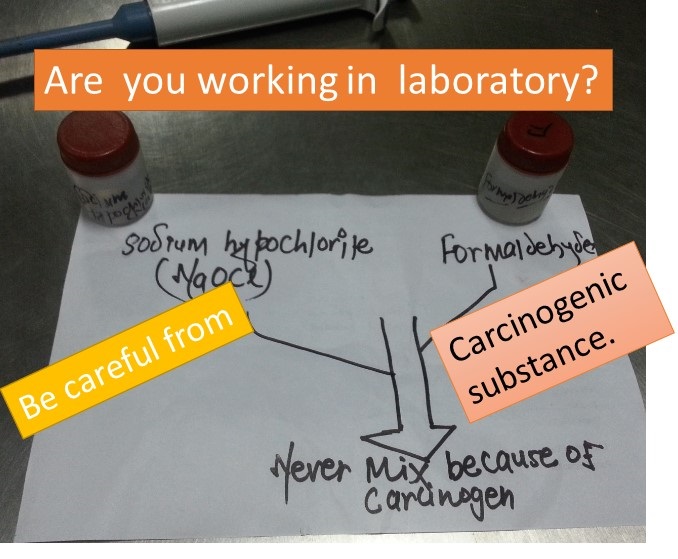
- As you know sodium hypochlorite (NaOCl) is the common disinfectant easily available in your workstation. Similarly, formaldehyde is also easily available in the histopathology section therefore be careful from mixing these two chemicals because of its carcinogenic nature.
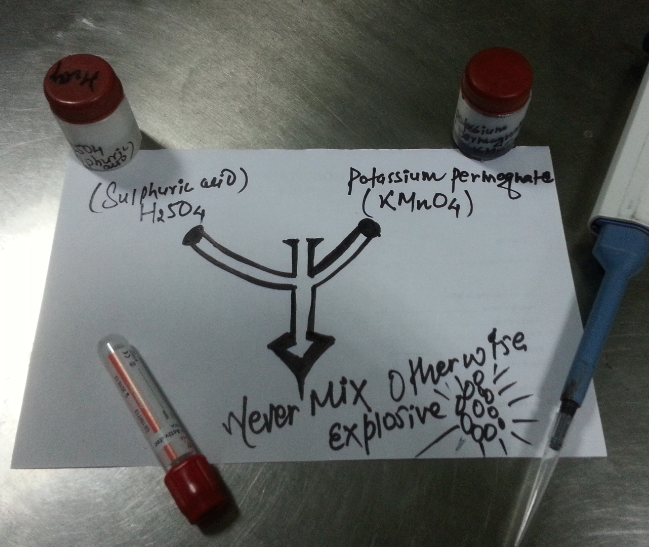
- Sulphuric acid is also a common reagent and potassium permanganate is also a useful reagent for various purposes in laboratories. When these two reagents mix together, they become explosive
Laboratory acquired infections (LAIs) are defined as all infections acquired through laboratory or laboratory-related activities regardless of whether they are symptomatic or asymptomatic in nature.
Laboratories Infections
- Used to be a common complication associated with microbiological work (mouth-pipetting, smoking, drinking coffee)
- A great decrease during the last decades due to improvement in laboratories practice
What kind of infections?
According to 2017 data,
- Bacterial 58%
- Viral 27%
- Parasites and
- fungi 15%
Active surveillance of 5000 laboratories in the US: 3.921 cases of LAI, 4,1% mortality (1930-1974)
-Sulkin and Pike (1951-76)
Top-eight laboratories acquired infections
-Sulkin and Pike (1951-76)
- Brucellosis
- Q fever
- Typhoid fever
- Hepatitis
- Tularaemia
- Tuberculosis
- Dermatomycosis
- VEE – Venezuelan equine encephalitis
But recent laboratory-acquired infections are as follows-
- Salmonella bacteria
- Brucella bacteria
- Neisseria meningitidis
- Vaccinia virus
- Francisella tularensis
- Filovirus ( Ebola virus and Marburg virus)
- Escherichia coli (O157:H7)
- Mycobacterium bacteria
- Staphylococcus aureus
- Bacillus anthracis and Bacillus cereus
- Burkholderia pseudomallei and Burkholderia mallei
- Clostridium difficle
- Chlamydophila psittaci
- Cowpox virus
- Dengue virus
- Leptospirosis bacteria
- Severe acute respiratory syndrome virus (SRAS) and Coronavirus
- Shigella sonnei
Bibliography
- https://www.cdc.gov/labs/BMBL.html?CDC_AA_refVal=https%3A%2F%2Fwww.cdc.gov%2Fbiosafety%2Fpublications%2Fbmbl5%2Findex.htm
- file:///C:/Users/acer/Downloads/Laboratory%20acquired%20infections%20Oct%2018.pdf
- Textbook of Medical Laboratory Technology by Praful B. Godkar, Darshan P. Godkar
- https://www.cdc.gov/mmwr/preview/mmwrhtml/su6101a1.htm?s_cid=su6101a1_w
- Mackie and Mc Cartney Practical Medical Microbiology. Editors: J.G. Colle, A.G. Fraser, B.P. Marmion, A. Simmous, 4th ed, Publisher Churchill Living Stone, New York, Melborne, Sans Franscisco 1996.
- Text book of Diagnostic Microbiology. Editors: Connie R. Mahon, Donald G. Lehman & George Manuselis, 3rd edition2007, Publisher Elsevier.
[1785 visitors]