
Diphtheria Bacillus Versus Diphtheroids: Introduction and Differences in Details

Introduction of Diphtheria bacillus versus Diphtheroids
Diphtheria bacillus versus Diphtheroids can easily understand. Diphtheria is an acute, toxin-mediated disease caused by toxigenic Corynebacterium diphtheriae (Diphtheria bacillus). It’s a very contagious and potentially life-threatening bacterial disease. An infection of local tissue of upper respiratory tract with the production of toxin which causes systemic effects on Heart and Peripheral tissues. It’s a localized infectious disease, which usually attacks the throat and nose mucous membrane.
Diphtheria bacillus
Corynebacterium diphtheriae
classification
Domain: Bacteria
Phylum: Actinobacteria
Order : Actinobacteriales
Family: Corynebacteriaceae
Genus: Corynebacterium
Species: diphtheriae
Binomial name-
Corynebacterium diphtheriae
Special features
Slender rods
Measuring 3.5× 0.4-0.8 µm
Club shaped swelling at one or both ends so the name
Pleomorphic and irregularly stained with granules
Bacilli seen in pairs, palisades or small groups and it varies angles to each other, resembling letter V and L also called angular fashion like Chinese lettering or cuneiform arrangement
Not capsulated
Gram-positive rod
Non-acid fast
Granules are composed of polymetaphosphate
Staining with Loffler’s methylene blue shows bluish-purple metachromatic granules with polar bodies
Diphtheroid
Resembles C. diphtheriae
Commensals in throat, skin, mucus membrane, and conjunctiva and they are-
Corynebacterium hofmannii
Corynebacterium xerosis
Propioniebacterium acnes
Propioniebacterium granulosum etc.
Differences between Diphtheria bacillus and Diphtheroids
Differentiation features of Diphtheria bacillus versus Diphtheroids on the basis of the following properties are as follows:
- Metachromatic granules in the short form
- Parallel rows of 3-4 bacilli (palisade formation)
- Size and shape
- Culture on basal media (peptone water, Nutrient agar)
- Tellurite blood agar
- Sucrose fermentation
- Toxigenicity
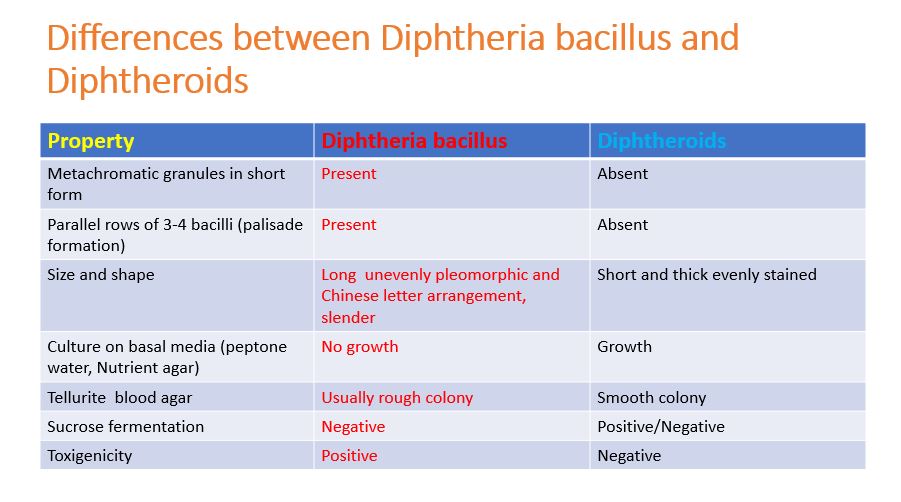
On these properties, Diphtheria bacillus versus Diphtheroids can clearly understand as shown above image.
Further Readings
- Topley and Wilson’s microbiology and microbial infection Topley and Wilson’s microbiology and microbial infection – Bacteriology-2-10th Edn.
- Manual of Clinical Microbiology -Patrick R. Murray -8th Edn.
- Bailey and Scott’s Diagnostic Microbiology -13th Edn.
- Mackie & Mc Cartney Practical Medical Microbiology- 14th Edn.
- Diagnostic Microbiology -Connie R. Mahon & George Manuselis
- Cowan and Steel’s, manual for the identification of medical bacteria
- Koneman Color Atlas and Textbook of Diagnostic Microbiology-6th Edn.
- Jawetz Melnick and Adelberg’s Medical Microbiology- 25th Edn.
- Lippincott’s –Illustrated- review-Microbiology-3rd Edn.
- Mandell’s Infectious Disease-7th Edn.
- Bergey’s Manual of Systemic Bacteriology – 2nd Edn.
- Medical Microbiology-The Practice of Medical Microbiology Vol-2-12th Edn. –Robert Cruickshank
- District Laboratory Practice in Tropical Countries – Part-2- Monica Cheesebrough- 2nd Edn Update