
Blastocystis hominis in Sargeaunt’s Stain of Stool: Introduction, Pathogenecity, Laboratory Diagnosis and Treatment
Introduction of Blastocystis hominis
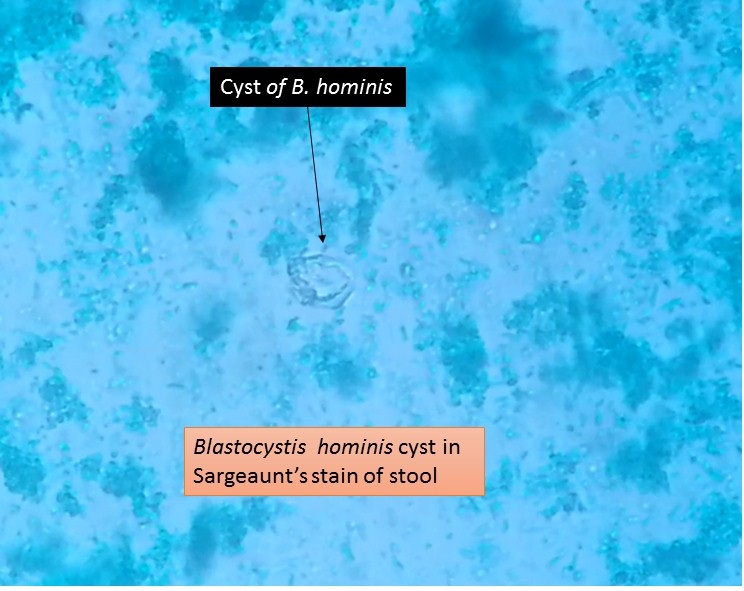
Blastocystis hominis cyst is in Sargeant’s stain of the stool as shown above image. Various forms that may occasionally be found in human stool specimens are cyst form, vacuolar form, binary fission or mitotic forms, granular forms, and amoeboid form. Among them, the cyst form (3–5 µm) is postulated to be an infectious stage but is not confirmed. The common form found in human stool specimens is referred to as the vacuolar form and it is of variable size i.e. 5–40 µm or occasionally much larger.
Blastocystis hominis is a protozoan parasite that colonizes the intestines of humans without causing harm. Sometimes, it is involved in the stools of people who have ingested contaminated food or water. Healthy people are lacking digestive symptoms, while it’s also sometimes found in the stools of people who have diarrhea, abdominal pain, or other gastrointestinal problems.
Pathogenicity of Blastocystis hominis
It is unclear whether Blastocystis causes disease. Most people who carry the organism have no signs or symptoms, but it’s also found in people who have diarrhea and other digestive problems. Blastocystis often appears with other organisms, therefore it’s not known whether it causes disease. The mode of transmission is feco-oral route. The organism gets into the digestive system when people eat contaminated food or are exposed to the stool of a contaminated person, such as when changing a diaper in a child care setting. The load of the organism in stool increase where there’s inadequate sanitation and poor personal hygiene.
Sign and Symptoms
Possible signs and symptoms due to association with Blastocystis hominis are as follow-
- Watery diarrhea
- Abdominal pain
- Nausea
- Loss of appetite
- Bloating
- Excessive gas (flatulence)
- Fatigue
Laboratory Diagnosis of Blastocystis hominis
Stool examination
Endoscopy
Blood tests
Sargeaunt stain preparation
Composition to make 50 ml
- Malachite green: 0.1 gm
- Glacial acetic acid : 1.5 ml
- Ethanol, 95% (v/v): 1.5 ml
- Distilled water: 47 ml
- Weigh the malachite green and transfer it to a container of 10 ml capacity.
- Measure the ethanol and glacial acetic acid and add to the stain.
- Mix it until the stain is fully dissolved.
- Add the water and mix well.
- Label the container and store it at room temperature.
- The stain is stable indefinitely.
Stool examination can be achieved by following methods-
Test procedure of Sargeaunt’s stain
- Make a saline suspension of stool in a small tube.
- Add 2-3 drops of Sargeaunt’s stain.
- Mix it properly.
- Leave the suspension at least six hours or overnight.
- Examine microscopically for stained chromatoid bars.
- Observe the smear first under the low power (10 X) objective, and then under the high power (100 X) objective.
Result Interpretation
Chromatoid bars green: Positive
Other than green: Negative
Result: But here we used Sargeaunt’s stain for searching chromatoid bodies of Entamoeba histolytica/dispar. Fortunately, we got a vacuolar form of Blastocystis hominis.
Note: Other than Sargeaunt’s stain uses for observation chromatoid bodies of Entamoeba histolytica/dispar are Burrow’s stain ( takes blue color) and acridine orange ( fluorochrome stain).
Treatment of Blastocystis hominis
There is no proven treatment for Blastocystis hominis. If you have no signs or symptoms, then you don’t need treatment whereas mild signs and symptoms might improve on their own within a few days. But in critical conditions, it can be treated using the following antimicrobial agents-
- Metronidazole or tinidazole
- Combination medications, such as sulfamethoxazole and trimethoprim
- Anti-protozoal drugs, such as paromomycin or nitazoxanide
Prophylaxis
Personal prophylaxis:
- Use of boiled drinking water
- Protection of food and drink from flies, cockroaches, and rats
- Not eating raw vegetables and fruits
- Personal cleanliness and elementary hygiene
Community prophylaxis:
- Effective sanitary disposal of feces
- Protection of water supplies from fecal contamination
- Avoidance of the use of human excrement as fertilizer
- Detection and isolation of carrier
Bibliography
- https://www.cdc.gov/dpdx/blastocystis/index.html
- https://www.mayoclinic.org/diseases-conditions/blastocystis-hominis-infection/symptoms-causes/syc-20351205
- Isenberg clinical microbiology procedures Handbook
2nd edition. Vol. 2 - Merkell and Voge’s medical parasitology
9th edition. - Parasitology: 12th edition
By K. D. Chatterjee - District laboratory practice in Tropical countries –Part-I.
By Monica Chesbrough.