
Immunology Short Notes: Introduction and Related Topics
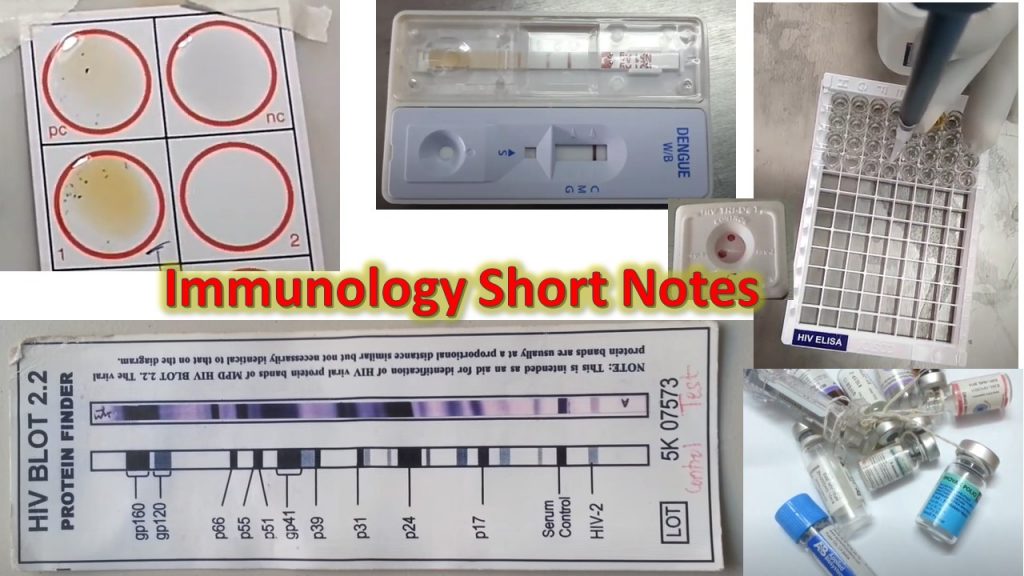
Immunology Short Notes
‘Immunology Short Notes’ makes it easier to understand subject immunology as well as to secure good marks in the examination for multiple-choice questions (MCQs).
Types of Immunity
1. Innate/ natural / native
2. Acquired / adaptive / specific
Innate immunity: Innate immunity is resistance to infection which is present by birth.
(a) Species immunity:
e.g. Birds are resistant to tetanus.
Chicken is resistant to Anthrax
(b) Racial immunity:
e.g. Algerian sheep immune to Anthrax
Negroes resistance to malaria
A person deficient in glucose 6 phosphate dihydrogen (G6PD) is less susceptible to Plasmodium falciparum.
(c) Individual immunity: seen in an endemic area
A person with blood groups’ O’ and ‘B’ is more resistant to smallpox than those of blood group A.
2. Acquired / adaptive/specific: Resistance acquired by an organism during life
Mechanism:
(1) Cell-mediated: provided by T cell
(2) Humoral immunity: provided by B cell by producing antibody
Types
(a) Active
Natural active: acquired by natural infection or disease eg.
immunity after recovery of measles
Artificial active: immunity provided by vaccination
(b) Passive
Natural passive: e.g. immunity passively transferred from mother to fetus through the placenta.
Artificial passive: e.g. it is the immunity produced when ready-made antibodies are administrated into the body.
Vaccine
(a) Bacterial vaccine
Live attenuated: BCG, Anthrox, Brucella, Plague
Killed : (enteric fever), cholera, Pertussis
(b) Viral vaccine
Live attenuated: smallpox, measles, influenza, mumps, Sabin (poliomyelitis), yellow fever.
Killed: Salk (Poliomyelitis), rabies, influenza
(c) Toxoid
Bacteria: e.g. Diphtheria, Tetanus
(d) Structural component Bacterial – Pneumococeal, H. influenzae
Viral – hepatitis ‘B’ ( HBsAg)
Antigens
(a) Complete antigen or immunogen:- capable to induce the formation of an antibody.
(b) Hepten or incomplete antibody:- are incomplete antigen, require carrier protein for immunogenicity (antibody production)
Epitope:- Antigenic determinants on the antigen.
Paratope:- Antigen binding site on the antibody.
Valency:- No. of epitope (no. of antigenic determinants)
Total valency = functional + non functional
Antibodies/ Immunoglobin
The glycoprotein comprises (20-25) % of serum protein.
- Produced by plasma cell (mostly ) and B lymphocytes
Structure
Inverted Y shaped, 2H ( heavy), 2L ( light chain bonded by disulfide (S-S) bonds; contains 2 Fab fragment and 1Fc fragment
- Fc ( Crystallizable fragment: fixes complement
- Fab binds antigen
- Fab terminal have amino and Fc terminal have- COOH group
- L and H chain consists of 2 parts
V (variable) region at amino-terminal and C ( constant ) region at carboxyl terminal
- Hypervariable region: bind epitope ( also called complement determining regions, CDR)
Types of antibodies
(1) 1gG:
- Only immunoglobin that can cross the placenta
- Consists light chain λ and heavy chain γ
- Major immunology in serum (80% of total)
- Mol. wt → 150 KD and its half-life 21 days (longest half-life)
- Major features: secondary response, cross placenta, opsonization, complement activation, antibacterial, antiviral, and antitoxin.
(2) IgM:
- Pentamer consists of the heavy chain (µ) and its mol. wt. → 900 (millionaire molecule) KD ( highest) and T ½ = 10 days.
- Appears early in response to acute infection
- Complement activation, antibacterial, antiviral and good agglutinater.
(3) IgA
Serum IgA (monomeric)
Secretory IgA (dimeric)
- Principle antibody that appears in secretion e.g. milk, saliva, tear
- Consists pf heavy chain (α), having t ½= 6 days
(4) IgD
- Consists heavy chain (δ ) and is present on the lymphocyte cell surface that serves as a recognition receptor for antigen.
(4) IgE
- also called reagin
- mediates type I hypersensitivity reaction
- Has the lowest half-life (2 days) and inactivates by heat at 56°C (i.e only chain IgE)
- consists of the heavy chain (ε)
Major features: Binds to mast cell, play role in allergic and parasitic infection, mediate hypersensitivity.
Note: All the antibodies consist of either K or λ type of light chain.
Antigen-Antibody reaction
- Ag- Abreaction is reversible, occurs at the surface and there is no denaturation of Ag and Ab during the reaction.
Types
1. Precipitation reaction: ( more sensitive for Antigen detection ) when soluble antigen combines with its antibody in the presence of electrolyte forms insoluble ( visible) precipitates. e.g. Elek’s test, Biken test
2. Flocculation: Special type of precipitation where precipitates remain suspended instead of sedimentation. e.g. VDRL, Kahn test , RPR
3. Agglutination
- More sensitive than precipitation for antibody detection
- Antigen-Antibody reaction in which antibodies combine with a particulate antigen. e.g.
- Slide agglutination: serotyping ( blood grouping and cross match)
- Tube agglutination: Widal test, Weill- Felix reaction, Paul Bunnel test.
4. Indirect passive haemagglutination:
- Where antibodies are coated on RBC
- Turkey red cells are often used as carrier particles because they are nucleated and sediment rapidly.
- Red cells coated with antigen are called sensitized cells e.g. TPHA
5. Reverse passive haemagglutination:- The technique utilizes stabilized red cells coated with specific viral antibodies.
6. Antiglobulin ( Coomb’s) test → To detect anti-Rh Ab and incomplete antibody of brucellosis
7. Neutralisation Tests
When antitoxin combines with its corresponding toxin, neutralization occurs
e.g. Schick test ( diphtheria), Dick test ( Streptococcus)
8. Radio -Immunoassay (RIA)
- Major analytes up to pictogram ( 10-12g) quantities
- The most common label used is radio Isotopes and measured by gamma-spectrometer
- used for quantification of hormones, drugs, tumor, marker, viral antigen, etc.
9. Enzyme Immuno Assay (EIA)
- measure enzyme-labeled antigen, antibody
- may be homogenous or heterogenous
Major types of heterogenous EIA is ELISA
ELISA (enzyme-linked ImmunoSorbent Assay)
This technique involves the use of an enzyme system and an immunosorbent (absorbing materials specific for one component of reaction, antigen, or antibody). The absorbing materials could be either. e.g. agarose matrix (microwell, membrane)
Enzyme used:
- horseradish peroxidase
- alkaline phosphatase
Substrate used:
- O- Phenyl diamine dihydrochloride- for peroxidase
- P- nitrophenyl phosphate – for alkaline phosphatase
Immuno Blotting technique
- Southern blotting – detect DNA
- Northern blotting- detect DNA
- Western blotting- defection protein ( confirmatory test of HIV)
- Easter blotting: Protein post-translational modifications including the addition of lipids, phosphates, and glycoconjugates
Modification of ELISA
- Indirect ELISA:- detect antibody → Antigen is coated on the plate surface
- Direct ELISA/Sandwich ELISA: detect antigen → Antibody is coated on the plate.
Hypersensitivity
1. Type 1 ( Immediate or reaginic)
e.g. Utricaria: hey fever and some form of asthma, Cosoni’s test
2. Type 2 ( Antibody-dependent – cytotoxic)
e. g.
- Rh hemolytic disease (HDN)
- Transfusion reactions
- autoimmune reaction: e.g. Myasthenia gravis, thyrotoxicosis, acute rheumatic fever.
3. Type 3 (Immune complex)
e. g.
- Arthus reaction
- Serum sickness
- Schick test
- Rheumatoid arthritis
4. Type 4 ( Cell-mediated)
e.g.
- Tuberculin test
- Lepromin test
- Graft rejection
- Fairley’s (Schistosomiasis) test
Contd…