
BHI Broth: Introduction, Composition, Principle, Preparation, Test Procedure and Uses
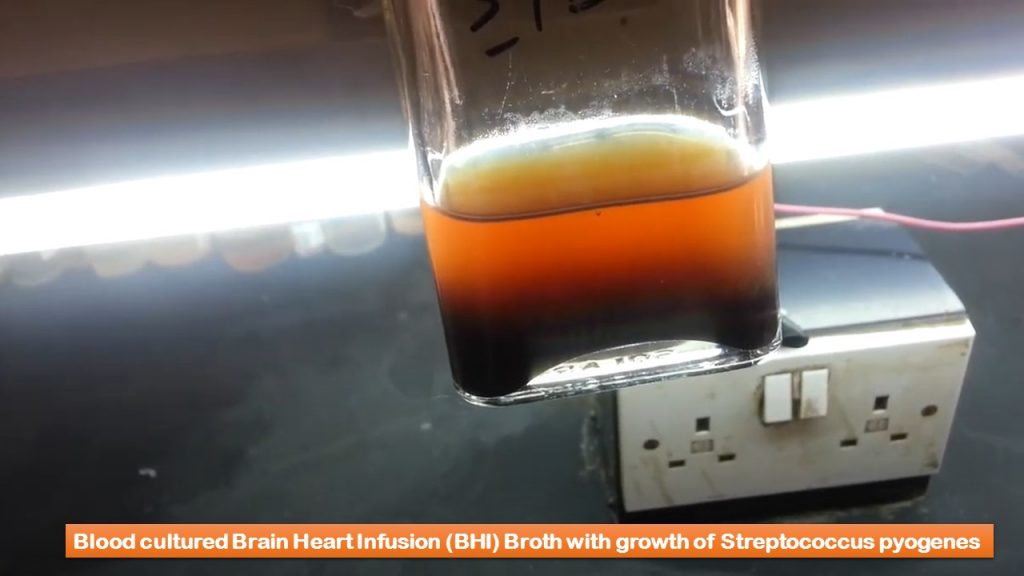
Introduction of BHI Broth
Brain Heart Infusion (BHI) broth is a highly nutritive medium and thus useful for cultivating a wide variety of microorganisms like aerobic and anaerobic bacteria, yeasts, and molds. BHI broth is commonly used in blood culture work and allied pathological investigations.
Composition of BHI Broth
Ingredients Gms / Litre
- HM infusion powder: 12.5
- BHI powder: 5.0
- Proteose peptone: 10.0
- Dextrose (Glucose): 2.0
- Sodium chloride: 5.0
- Disodium hydrogen phosphate: 2.5
- Final pH (at 25°C): 7.4
Principle of BHI Broth
BHI broth constituents like proteose peptone, HM infusion powder, and BHI powder work as sources of carbon, nitrogen, essential growth factors, amino acids, and vitamins. Dextrose is the source of energy. Disodium phosphate (KH2PO4) keeps maintaining the buffering action of the medium whereas sodium chloride maintains the osmotic equilibrium of the medium.
Preparation of BHI Broth
- Suspend 37.0 grams in 1000 ml purified/distilled or deionized water.
- Heat to boiling to dissolve the medium completely.
- Desired volumes and containers ( vial or tube or bottle) can be taken according to the nature of the testing purpose.
- Sterilize by autoclaving at 15 lbs pressure (121°C) for 15 minutes.
- After autoclaving, leave for cooling to room temperature.
- Store the plates in a refrigerator at 2-8°C.
Storage and Shelf life of BHI Broth
- Store at 2-8ºC and away from direct light.
- Media should not be used if there are any signs of deterioration or contamination.
- The product is light and temperature-sensitive; protects from light, excessive heat, moisture, and freezing.
Test Requirements
- Test specimens ( samples or growth of test organisms)
- Inoculating loop
- Bunsen burner
- Incubator
- Control strains (Escherichia coli ATCC 25922, Staphylococcus aureus
ATCC 25923, and Candida albicans ATCC 10231)
Test procedure ( specimen/organism inoculation)
- Allow the medium to warm at 37°C or to room temperature.
- Inoculate the specimen as soon as possible after collection.
- Incubate aerobically at 35-37ºC for 18-24 hours.
- Examine for growth.
Result Interpretation
- Escherichia coli ATCC 25922: good-luxuriant
- Staphylococcus aureus ATCC 25923): good-luxuriant
- Candida albicans ATCC 10231: good-luxuriant
- To say growth nil ( negative): Subculture into solid medium and after incubation check the growth that is without colonies.
Modifications and Uses of BHI Broth
- BHI broth: To prepare inoculum suspensions for antimicrobial sensitivity testing (AST) and a medium for blood culture
- BHI broth with Hemin and Vitamin K: Anaerobic bacterial culture and the recovery of fastidious anaerobic organisms
- BHI with 10% defibrinated sheep blood: Isolation and cultivation of Histoplasma capsulatum and other fungi
- BHI broth with Fildes: cultivating capsular strains of Haemophilus influenzae
- BHI broth with 6.5% Sodium Chloride: It is used to differentiate enterococci from non-enterococcal group D streptococci.
Keynotes on BHI Broth
- BHI broth is also the medium for fastidious pathogenic cocci like Streptococcus pneumoniae, Streptococcus pyogenes, Neisseria meningitidis, and other streptococci.
- The addition of antibiotics, gentamicin, and/or chloramphenicol is recommended for selective isolation of fungi.
- For the culture of yeasts or mold, a prolonged incubation period may be required to obtain good growth.
- For Haemophilus species incubate in a CO2-enriched atmosphere at 35°C with a loose cap.
- The original BHI broth was made in 1899 when Edward Rosenow combined dextrose broth with calf brain tissue to grow streptococci and it was modified in 1923 by Russell Haden while working on dental pathogens. Modern BHI broth is different from Rosenow and Haden in which an infusion from porcine brains and hearts rather than calf brain tissue, and uses disodium phosphate as a buffer, rather than the calcium carbonate.
Limitations of BHI Broth
- Pure culture needs for organism identification. Colony characteristics, biochemical, and/or serological tests should be performed for final identification.
- Strains of other catalase-negative gram-positive cocci like Lactococcus, Leuconostoc, Pediococcus, and Vagococcus, have been isolated from clinical specimens. Therefore, the presumptive identification of enterococci based on the bile-esculin reaction and growth in 6.5% sodium chloride broth only cannot be made.
Further Reading
- https://www.himedialabs.com/TD/M210.pdf
- https://www.bd.com/resource.aspx?IDX=8441
- https://en.wikipedia.org/wiki/Brain_heart_infusion
- https://www.dalynn.com/dyn/ck_assets/files/tech/TB63.pdf
- https://anaerobesystems.com/products/broth-media/brain-heart-infusion-broth-bhi/
- https://assets.thermofisher.com/TFS-Assets/LSG/manuals/IFU60276.pdf
- https://www.amazon.com/Infusion-Percent-16x125mm-Hardy-Diagnostics/dp/B001IJFLLU
[5307 visitors]