

Introduction of Thiosulfate Citrate Bile Salts Sucrose (TCBS) Agar
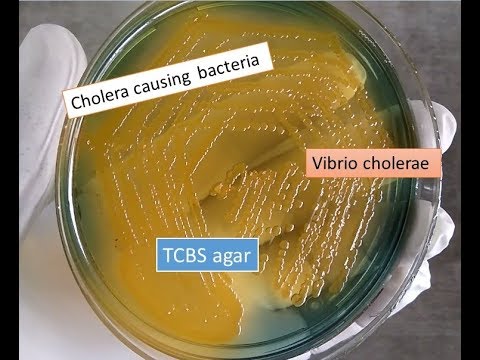
Vibrio cholerae is the causative agent of cholera and Thiosulfate Citrate bile salts sucrose (TCBS) agar a selective as well as differential culture medium used for selective isolation of this bacterium including its species from a variety of clinical and nonclinical specimens. TCBS agar has a very high pH (8.5-9.5) which suppresses growth of intestinal flora other than Vibrio spp. The bile salts inhibit growth of gram-positive microorganisms. Vibrio spp. produce either yellow or green colonies on TCBS agar , depending on whether they are able to ferment sucrose. If the sucrose is fermented, yellow colonies are produced. Vibrio cholerae produces yellow colonies in TCBS agar whereas Vibrio parahaemolyticus produces green colonies.
Composition of Thiosulfate Citrate Bile Salts Sucrose (TCBS) Agar
Ingredients Gms / Litre
- Proteose peptone 10.000
- Yeast extract 5.000
- Sodium thiosulphate 10.000
- Sodium citrate 10.000
- Bile 8.000
- Sucrose 20.000
- Sodium chloride 10.000
- Ferric citrate 1.000
- Bromo thymol blue 0.040
- Thymol blue 0.040
- Agar 15.000
- Distilled water (D/W) 1000 ml
Final pH ( at 25°C) 8.6±0.2
Function of Ingredients of TCBS Agar
- Yeast extract and proteose peptone: provide the nitrogen, vitamins, and amino acids in TCBS Agar
- Sodium thiosulphate and Sodium citrate: selective agents, providing an alkaline pH to inhibit Gram-positive organisms and suppress coliforms
- Bile: The bile salts inhibit growth of gram-positive microorganisms
- Sucrose: source of carbohydrate
- Sodium chloride: provide optimum growth and metabolic activity of halophilic Vibrio spp.
- Ferric citrate: Sodium thiosulfate is also a sulfur source, and acts with Ferric Citrate as an indicator to detect hydrogen sulfide production.
- Bromothymol blue and thymol blue: pH indicators
- Agar: Solidifying agent
Note : The need of alkaline pH is due to enhance growth of Vibrio cholerae, because this organism is sensitive to acid environments.
Procedure of Thiosulfate Citrate Bile Salts Sucrose (TCBS) Agar preparation
- Suspend 89.08 grams in 1000 ml distilled water.
- Heat to boiling to dissolve the medium completely.
- Do not autoclave.
- Cool to 45-50°C.
- Mix well before dispensing.
- Pour Thiosulfate Citrate Bile Salts Sucrose (TCBS) Agar into each plate and leave plates on the sterile surface until the agar has solidified.
- Store the plates in a refrigerator at 2-8°C.
Storage and Shelf life of TCBS Agar
- Store at 2-8ºC and away from direct light.
- Media should not be used if there are any signs of deterioration (shrinking, cracking, or discoloration), contamination.
- Product is light and temperature sensitive; protect from light, excessive heat, moisture, and freezing.
Type of specimen
As specimen feces, food samples and water may be used.
Interpretation of result for Thiosulfate Citrate Bile Salts Sucrose (TCBS) Agar
- Results of culture is read after overnight culture (18 to 24 hours).
- V. cholerae will produce large (2 to 4 mm in diameter), slightly flattened, yellow colonies with opaque centers and translucent peripheries. V. cholerae and its biotype Eltor ferment sucrose, this result in decrease in pH and production of yellow colonies.
- V. parahaemolyticus produces green to blue-green colonies as it does not ferment sucrose.
Quality control of Thiosulfate Citrate Bile Salts Sucrose (TCBS) Agar
- A medium of good quality gives following mentioned results when cultured at 35°C in aerobic condition for 18-24 hours.
- Vibrio cholerae ATCC 15748 :good-luxuriant growth, yellow colonies
- Vibrio parahaemolyticus ATCC 17802: good-luxuriant growth; bluish-green colonies
- Escherichia coli ATCC 25922: Inhibited
Limitations of Thiosulfate Citrate Bile Salts Sucrose (TCBS) Agar
- The medium should be inoculated heavily with fecal specimens because the growth of a few species may be inhibited on the medium due to the fermentation of sucrose and the accumulation of acids.
- However, occasional isolates of Pseudomonas and Aeromonas may also form blue-green colonies on TCBS Agar.
- Proteus species that are sucrose-fermenters may form yellow colonies.
- TCBS Agar is not a suitable medium for oxidase testing of Vibrio species.
- A few strains of V. cholerae may appear green or colorless on TCBS Agar due to delayed sucrose fermentation.
- TCBS Agar is highly selective for Vibrio species. Any H2Snegative colony of TCBS Agar can be considered presumptive positive for Vibrio .
- Further biochemical and serological tests must be carried out for complete identification.
# TCBS Agar and Vibrio Related Videos#
TCBS agar with Vibrio cholerae showing yellow colonies as shown below-
#Darting motility of bacteria Positive ||Vibrio cholerae ||Campylobacter jejuni as shown below-

#Vibrio cholerae and its growth on TCBS medium, biochemical tests-
TSI test
SIM test
Citrtate Utilization test
Urea hydrolysation test
Oxidation-Fermentation test
Decarboxylase test like
Orthine test
Lysine test
Arginine test and its interpretation as shown below-

#String test of Vibrio cholerae showing positive result as shown below-

#Vibrio antisea for serotyping as shown below-

References
- https://catalog.hardydiagnostics.com/cp_prod/content/hugo/TCBSAgar.htm
- http://himedialabs.com/TD/M189.pdf
- https://www.sigmaaldrich.com/catalog/product/sial/86348
- Merck Microbiology Manual 12th Edition
- https://legacy.bd.com/europe/regulatory/Assets/IFU/HB/CE/PA/PA-254432.pdf
- https://www.thermofisher.com/order/catalog/product/R01865#/R01865
- https://www.humeau.com/media/blfa_files/265020.pdf
- https://www.neogen.com/solutions/microbiology/thiosulfate-citrate-bile-salts-sucrose-agar/