
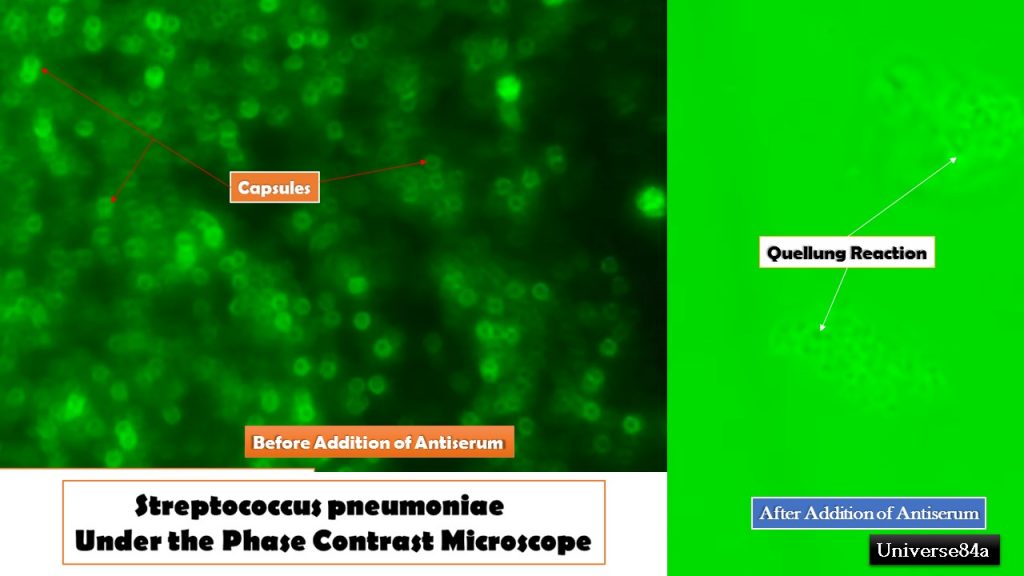
Introduction of Quellung Reaction
The quellung reaction is the swelling of the capsule and it is also called or Neufeld reaction which is the gold standard technique for serotyping pneumococcus and this quellung reaction was first described in 1902 by the scientist Fred Neufeld who applied this test only to Streptococcus pneumoniae. Capsular serotyping of the individual strains of S. pneumoniae is performed by the microscopic “precipitin test. This reaction is also applicable in the bacterial capsules other than S. pneumoniae are Klebsiella pneumoniae, Neisseria meningitidis, Bacillus anthracis, Haemophilus influenzae, E. coli, and Salmonella.
Principle of Quellung Reaction
The quelling reaction is a result of the interaction between Streptococcus pneumoniae (pneumococcal) capsular polysaccharide and its homologous antibody. The antigen-antibody reaction between antiserum and the capsule (antigen) causes the capsule swelling although the mechanism is probably because of a change in the refractive index of the capsule that enhances its visibility. After the addition of methylene blue (counterstain), the bacterial cells stain dark blue and are surrounded by a sharply demarcated halo that represents the outer edge of the capsule. The light transmitted through the capsule appears brighter than either the bacterial cell or the background.
Test Requirements
- Test organism
- Glass slides
- Marker
- 0.85% phosphate-buffered saline or in normal saline
- Antiserum
- Rabbit antisera
- Micropipette/ IUrine culture Inoculating loop
- Methylene blue
- Microscope
- Coverslip
- Cedarwood oil
- Control strains (Encapsulated Streptococcus pneumoniae and Non-capsulated strain)
Procedure of Quellung Reaction
- Take a clean and grease-free glass slide and divide it into two sections. Label one section for the test while the other for the control.
- Use18-24 hours old culture isolated colony from blood agar plate incubated at 35-37°C with 5% CO2 incubator.
- Pick up well-isolated colonies and mix into 0.5 ml of 0.85% phosphate-buffered saline or in normal saline (Optical density is equal to 0.5 McFarland standard).
- Place a drop of the diluted specimen using micropipette or urine culture inoculating loop (0.2-1 µl) suspension onto each of two sections of a slide, spread out, and allow to air dry.
- Put a small drop (5 µl) of antiserum on the first sections of a slide and spread it out over the specimen.
- Put an equal amount of rabbit serum (5 µl) on the second section of the slide.
- Place equal amount (5 µl) of methylene blue solution on each of two cover-slips. Invert the cover-slips onto each section of the slide.
- Incubate at room temperature (25 ± 5 °C) for 10-15 minutes.
- After completion, read the test and control sections of the slide using the 100X objective of the microscope.
Result Interpretation of Quellung reaction
- Quellung reaction Positive: Capsule appears as a sharply demarcated halo
- Quelling reaction Negative: Lacking appearance of a clear, enlarged halo surrounding the bacterial cell
- Control strains-Encapsulated Streptococcus pneumoniae-Positive while non-capsulated strain -negative
Uses of Quellung Reaction
- It is the recommended serotyping technique for Streptococcus pmeniminae.
- It is a tool for understanding pneumococcal epidemiology or one of the phenotypic methods of detection epidemiological markers i.e. epidemiological surveillance.
- Capsular serotyping can give useful information for vaccine efficacy and impact studies
- It is also an applicable method for other encapsulated bacteria other than pneumococcus are Klebsiella pneumoniae, Neisseria meningitidis, Bacillus anthracis, Haemophilus influenzae, E. coli, and Salmonella.
Limitations of Quellung Reaction
- Quellung reaction test negative does not say that the organism is not Strptococcus pneumoniae, because the bacteria could have lost the ability to express a capsule.
- The test can be falsely negative due to the Postzone phenomenon if there are a heavy load of organisms on the slide (antigen excess), if this occurs, the test should be repeated with fewer organism.
- In doubtful cases, additional tests should be performed like optochin susceptibility, bile solubility, Gram stain, etc.
- False-negative reactions may happen in the young culture (4-hours broth test) due to insufficient growth. In such cases, the colony test should be performed using a fresh 18 hours subculture.
- Multiple subculturing should be prohibited since it may lose the capsule expression of the organisms.
Keynotes on Quellung Reaction
- There are more than 90 different capsular serotypes of S. pneumoniae.
- The commercially available sera are pooled, group, or serotype-specific.
- The quellung reaction is a reasonably simple and rapid technique to perform and can be applied wherever a suitable microscope and antisera are available.
- This method involves testing a pneumococcal cell suspension with pooled and specific antisera directed against the capsular polysaccharide.
- It is recommended to first test with pooled antisera in succession until a positive reaction is observed. Typing should then perform by testing with the individual group and serotype-specific antisera included in the antisera pool that gave a positive quelling reaction to determine the serogroup and serotype.
- Rapid latex agglutination test for S. pmeimoniae is available in which rapid visible agglutination occurs when the S. pneumoniae capsular antigen reacts with the antibody-coated latex beads.
- When reading the reactions, look for free-floating single or paired cells since agglutination or cells clumping together is NOT a positive quellung reaction.
- Rapid diagnosis of pneumococcal pneumonia among HIV-infected adults with urine antigen detection by ICT is also a useful tool.
Further Readings
- https://www.ncbi.nlm.nih.gov/pmc/articles/PMC4131683/
- lww.com/aidsonline/fulltext/2019/05010/postzone_phenomenon_resulting_in_a_false_negative.20.aspx
- https://legacy.bd.com/ds/technicalCenter/clsi/clsi-Pneumo.pdf
- https://en.wikipedia.org/wiki/Quellung_reaction
- net/publication/6147983_Rapid_diagnosis_of_pneumococcal_pneumonia_among_HIV-infected_adults_with_urine_antigen_detection