
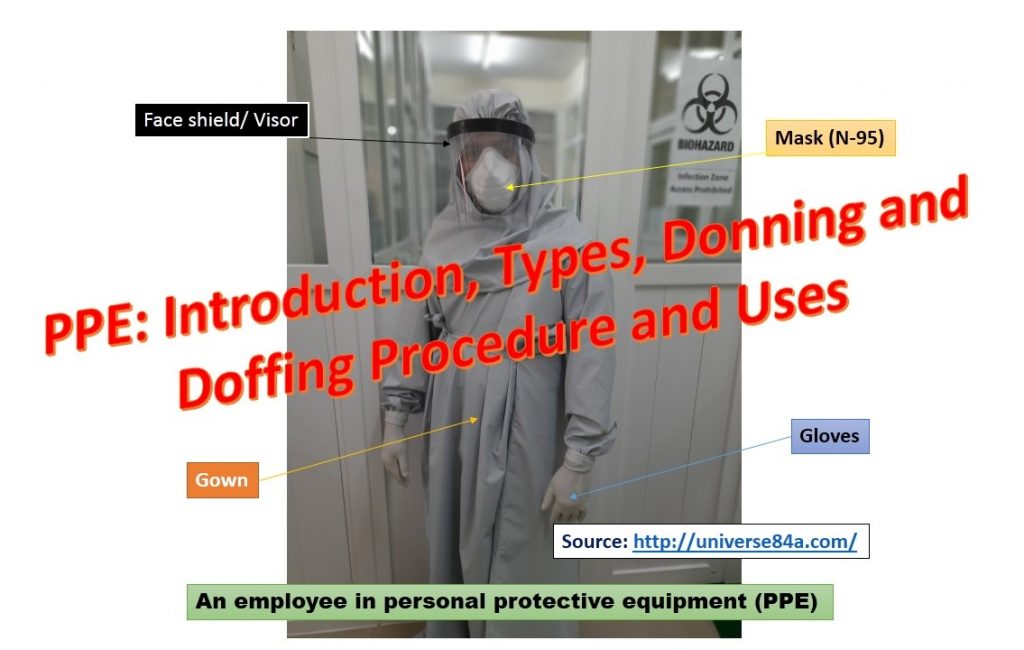
Introduction of PPE
PPE stands for personal protective equipment. Definition of PPE according to OSHA (Occupational Safety and Health Administration)-“PPE is specialized clothing or equipment, worn by an employee for protection against infectious materials.” It includes gloves, gowns or aprons, shoe covers, head covers, masks, respirators, eye protection, face shields, and goggles. Its donning means putting on and PPE doffing mean taking off or removing PPE. PPE donning and doffing is a very important method in health care set up for health care workers to save yourself and surrounding to save from infectious materials.

Types of PPE
All of the personal protective equipment listed here prevent contact with the infectious agent, or body fluid that may contain the infectious agent ( bacteria, virus, fungi, parasites) , by creating a barrier between the worker and the infectious material. Gloves, protect the hands, gowns or aprons protect the skin and clothing, masks and respirators protect the mouth and nose, goggles protect the eyes, and face shields protect the entire face. The respirator has been designed to also protect the respiratory tract from the airborne transmission of infectious agents e.g. Mycobacterium tuberculosis, SARS-COV-2, etc. Decisions regarding when and which type of personal protective equipment should be worn are determined by CDC recommendations for Standard Precautions and Expanded Isolation Precautions.
Standard Precautions
- Previously called Universal Precautions
- Assumes blood and body fluid of a patient could be infectious
- Recommends personal protective equipment and other infection control practices to prevent transmission in any healthcare setting
- Decisions about personal protective equipment use are determined by the type of clinical interaction with the patient
PPE for Standard Precautions (1)
- Gloves – Use when touching blood, body fluids, secretions, excretions, contaminated items; for touching mucus membranes and non-intact skin
- Gowns – Use during procedures and patient care activities when contact of clothing/exposed skin with blood/body fluids, secretions, or excretions is anticipated
Personal protective equipment for Standard Precautions (2)
- Mask and goggles or a face shield – Use during patient care activities likely to generate splashes or sprays of blood, body fluids, secretions, or excretion
Personal protective equipment for Expanded Precautions
- Expanded Precautions include
– Contact Precautions
– Droplet Precautions
– Airborne Infection Isolation
Use of PPE for Expanded Precautions
- Contact Precautions – Gown and gloves for contact with patient or environment of care (e.g., medical equipment, environmental surfaces)
- In some instances, these are required for entering patient’s environment
- Droplet Precautions – Surgical masks within 3 feet of the patient
- Airborne Infection Isolation – Particulate respirator-Negative pressure isolation room also required
What Type of PPE Would You Wear?
- Giving a bed bath? -Generally none
- Suctioning oral secretions? -Gloves and mask/goggles or a face shield sometimes gown
- Transporting a patient in a wheelchair?-Generally, none required
- Responding to an emergency where blood is spurting?- Gloves, fluid-resistant gown, mask/goggles, or a face shield
- Drawing blood from a vein?-Gloves
- Cleaning an incontinent patient with diarrhea?-Gloves with or without a gown
- Irrigating a wound?-Gloves, gown, mask/goggles, or a face shield
- Taking vital signs?-Generally none
Where to Remove personal protective equipment
- A doorway, before leaving the patient room or in the anteroom
- Remove respirator outside the room, after the door has been closed
- Ensure that hand hygiene facilities are available at the point needed, e.g., sink or alcohol-based hand rub
Donning and Doffing Procedure
Sequence for Donning PPE
- Gown first
- Mask or respirator
- Goggles or face shield
- Gloves
Note: Combination of PPE will affect sequence and thus be practical.

Sequence for taking off PPE
- Gloves
- Face shield or goggles
- Gown
- Mask or respirator

Uses
- It is available to protect you from exposure to infectious agents in the healthcare workplace.
- Gloves protect hands.
- Gowns or aprons protect skin and/or clothing.
- Masks and respirators protect the mouth/nose.
- Respirators protect the respiratory tract from airborne infectious agents.
- Goggles protect eyes.
- Face shields protect the face, mouth, nose, and eyes.
Keynotes
- Don personal protective equipment before contact with the patient, generally
before entering the room
-Use carefully – don’t spread contamination
– Remove and discard carefully, either at the doorway or immediately outside the patient room; remove respirator outside the room
– Immediately perform hand hygiene - Know what type of PPE is necessary for the duties you perform and use it correctly.
- How to Safely Use personal protective equipment
- Keep gloved hands away from face-Avoid touching or adjusting other PPE-Remove gloves if they become torn; perform hand hygiene before donning new gloves-Limit surfaces and items touched.
Further Readings
- https://www.cdc.gov/hai/pdfs/ppe/ppeslides6-29-04.pdf
- https://www.aaha.org/aaha-guidelines/infection-control configuration/protocols/personal-protective-equipment/
- https://www.who.int/csr/resources/publications/Contact-Droplet-COVID-19-Precautions.pdf?ua=1
- https://www.health.state.mn.us/facilities/patientsafety/infectioncontrol/ppe/comp/index.html
- http://www.cdc.gov/niosh/npptl/respirators/
respsars.html - http://www.cdc.gov/niosh/99-143.html
- http://www.cdc.gov/niosh/topics/respirators