
Introduction
The NALC-NaOH (N-acetyl-L-cysteine–sodium hydroxide) method is the gold standard for processing clinical specimens in mycobacteriology laboratories. It prepares contaminated samples (like sputum) for successful culture on liquid media (such as the BD BACTEC™ MGIT™ 960) and solid media.
Clinical samples from non-sterile sites naturally contain rapidly growing normal flora (bacteria and fungi). If left unchecked, these organisms overgrow the slow-growing Mycobacterium tuberculosis (MTB), ruining the culture.
The NALC-NaOH method is a dual-action system:
- Decontaminant: Sodium hydroxide (NaOH) kills the competing non-mycobacterial flora.
- Mucolytic Agent: N-acetyl-L-cysteine (NALC) digests mucus and releases trapped mycobacteria.
Because Mycobacterium species possess a thick, lipid-rich cell wall, they survive this harsh chemical exposure better than other bacteria.
Working Principle
The procedure relies on a strict balance between effective decontamination and mycobacterial survival:
- Mucolysis: NALC breaks disulfide bonds in sputum mucin. This liquifies the sample, allowing the decontaminant to distribute evenly and releasing mycobacteria so they can be concentrated by centrifugation.
- Selective Toxicity: NaOH acts as a harsh disinfectant. A final concentration of 1% to 1.5% NaOH is toxic enough to kill normal flora but mild enough to preserve the viability of the majority of the mycobacteria.
- Stabilization: Sodium citrate is included in the mixture. It binds heavy metal ions present in the specimen that would otherwise oxidize and inactivate the NALC.
Reagent Preparation for NALC-NaOH Method for Mycobacterial Culture
Always use sterile distilled water and strict aseptic technique.
NALC-NaOH Stock Solution
- Combine equal volumes of 4% Sodium Hydroxide (NaOH) and 2.94% Trisodium Citrate.
- Sterilize the mixture by autoclaving. Allow it to cool completely.
- Note: This combined solution can be stored at room temperature for several weeks.
Working Solution (Prepare Fresh Daily)
- Calculate the total volume needed for the day’s batch.
- Add N-acetyl-L-cysteine (NALC) powder directly to the cooled NaOH-citrate solution at a ratio of 0.5 grams of NALC per 100 mL of solution.
- Mix thoroughly until the powder completely dissolves.
- Crucial: Discard any unused working solution at the end of the day because NALC rapidly loses activity when exposed to air.
Phosphate Buffer (0.067 M, pH 6.8)
- Prepare or purchase standard pH 6.8 phosphate buffer.
- Sterilize by autoclaving. This buffer stops the harsh decontamination process.
Step-by-Step Procedure
[Sputum Sample]
↓ Add Equal Volume of Working NALC-NaOH
[Vortex Mix] → [Vortex 15-30 sec] → [Invert Tube]
↓Incubate Exactly 15 Minutes at Room Temp
[Stop Reaction] →Add Sterile Phosphate Buffer (pH 6.8) to Top Ring
↓Centrifuge at 3,000 x g for 15 Minutes
[Decant Supernatant] → Pour off liquid into disinfectant
↓
[Resuspend Sediment] →Add 1-2 mL of Buffer → Ready for Smear & Culture
- Transfer: Place up to 5 mL of purulent or mucoid sputum into a sterile, graduated 50 mL plastic centrifuge tube.
- Add Reagent: Add an equal volume of the freshly prepared Working NALC-NaOH solution.
- Homogenize: Tighten the cap and vortex for 15 to 30 seconds. Invert the tube to ensure the liquid contacts all inner surfaces.
- Time: Incubate at room temperature (20°C to 25°C) for exactly 15 minutes.
- Neutralize: Stop the decontamination immediately at the 15-minute mark by adding sterile Phosphate Buffer (pH 6.8) up to the 45 mL mark.
- Concentrate: Centrifuge the tubes at 3,000 × g for exactly 15 minutes using a refrigerated, aerosol-tight centrifuge safety cup.
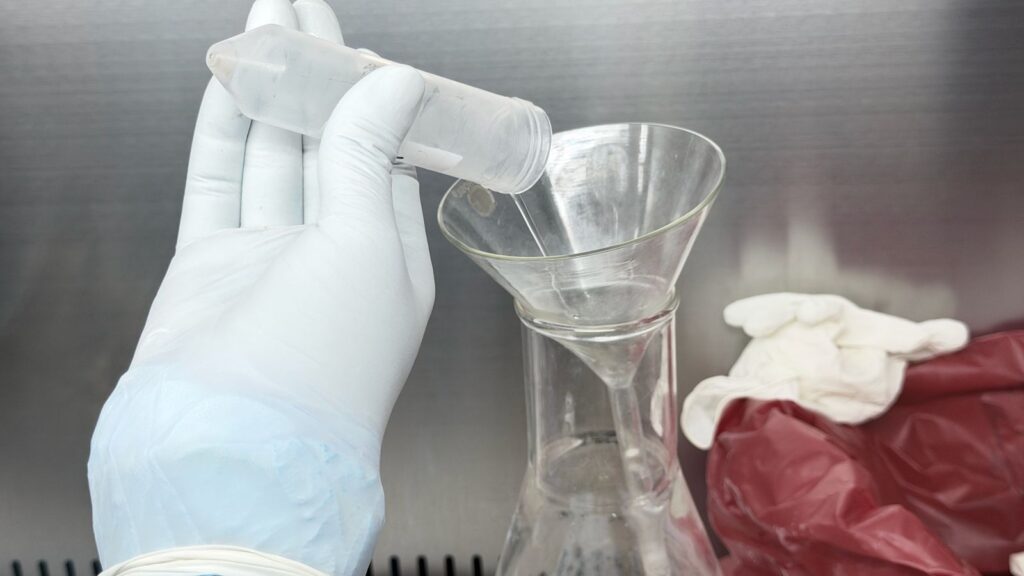
- Decant: Carefully pour off the supernatant into a waste container containing an appropriate disinfectant (e.g., 5% phenol or freshly diluted bleach). Do not let liquid run down the outside of the tube.
- Resuspend: Resuspend the remaining pellet (sediment) by adding 1.0 to 2.0 mL of sterile phosphate buffer. Mix gently.
- Inoculate: Use this concentrated sediment immediately to prepare acid-fast smears (AFB staining) and to inoculate culture media (like MGIT tubes for 0.5 ml or Lowenstein-Jensen slants -02 ml).
Key Applications
- Pre-Culture Processing: Mandatory step for isolating M. tuberculosis from non-sterile clinical sites (sputum, gastric washings, bronchoalveolar lavage, and contaminated tissues).
- Sample Concentration: Increases diagnostic sensitivity by concentrating scarce mycobacterial cells from a large volume into a small sediment pellet.
- Smear Optimization: Liquefaction ensures a uniform, thin smear on glass slides, making acid-fast bacilli easier to spot under the microscope.
Critical Lab Keynotes
- The 15-Minute Rule: Timing is the most critical variable. Exceeding 15 minutes of NaOH exposure will rapidly kill the M. tuberculosis bacilli, leading to false-negative cultures.
- Centrifugation Speed: Standard clinical centrifuges operating at lower speeds (RPM) fail to sediment mycobacteria effectively due to their high lipid content and low specific gravity. You must achieve 3,000 × g relative centrifugal force (RCF).
- Target Contamination Rate: A perfectly executed NALC-NaOH procedure should yield an acceptable diagnostic culture contamination rate of 2% to 5% in a healthy laboratory. A 0% contamination rate usually implies your technique is too harsh and is killing the target TB bacteria.
- Biosafety: This process generates highly infectious aerosols during vortexing and centrifugation. Perform the entire open-tube procedure inside a certified Class II Biosafety Cabinet (BSC) while wearing appropriate personal protective equipment (PPE), including an N95 or higher respirator.
Further Reading on NALC-NaOH Method for Mycobacterial Culture
- https://microbiozjournals.com/shifting-from-modified-petroff-s-to-nalc-naoh-method-for-processing-of-sputum-specimens-for-solid-culture/
- https://pmc.ncbi.nlm.nih.gov/articles/PMC8400212/
- #https://microbiology.mlsascp.com/digestion-decontamination.html
- https://microbiology.mlsascp.com/digestion-decontamination.html
- https://journals.lww.com/jcsm/fulltext/2021/07020/evaluation_of_hypertonic_saline_sodium_hydroxide.6.aspx
- https://patents.google.com/patent/US6579694B2/en
- https://journals.asm.org/doi/10.1128/microbiolspec.tnmi7-0022-2016
- https://www.ntep.in/node/1466/CP-culture-specimen-processing-advantages-and-disadvantages-nalc-naoh-method
- https://www.rroij.com/open-access/sputum-processing-prior-to-mycobacterium-tuberculosis-detection-by-culture-or-nucleic-acid-amplification-testing-a-narrative-revie-.php?aid=70860
- https://ntep.in/node/1962/CP-specimen-processing-tb-cultures
- https://hardydiagnostics.com/media/assets/product/documents/DecontamRgntRecovMyco.pdf
- https://pmc.ncbi.nlm.nih.gov/articles/PMC3574494/
- https://pmc.ncbi.nlm.nih.gov/articles/PMC3574495/
- https://www.moleculartb.org/files/documents/10
- https://pmc.ncbi.nlm.nih.gov/articles/PMC1933042/
- https://journals.sagepub.com/doi/pdf/10.1177/004947550303300313
- https://ntep.in/node/1737/CP-biosafety-tb-laboratory-factors-be-considered-tb-laboratory-risk-assessment