
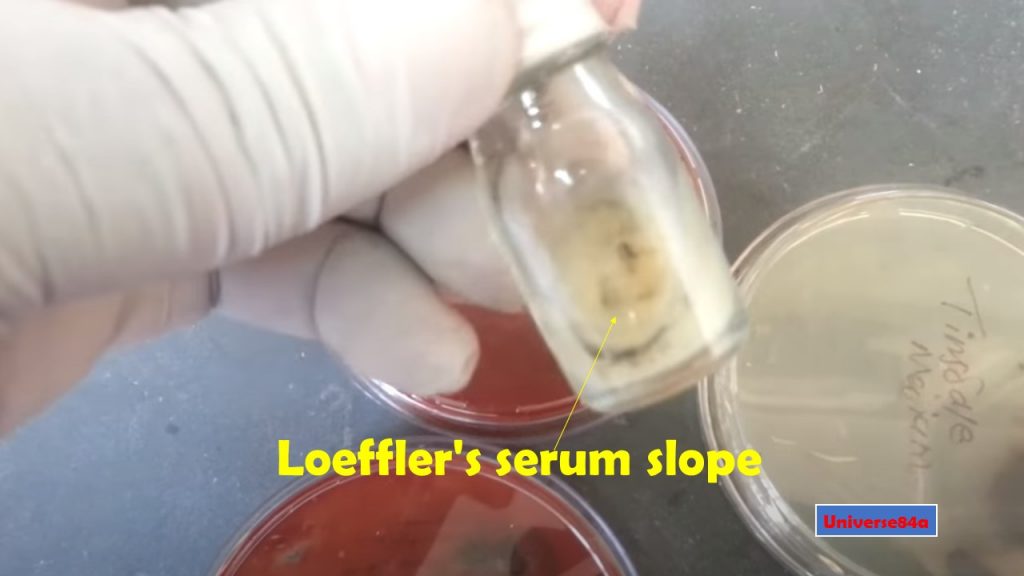
Introduction of Loeffler Serum Slope
Loeffler Serum slope is used for the cultivation of Corynebacterium diphtheriae. It was originally devised by Loeffler and further modified by Perry and Petran and Buck. Loeffler serum slope enhances primary and secondary isolation and cultivation of fastidious pathogenic microorganisms especially from the nose and throat which also restores virulence and other identifying properties after they have been lost due to prolonged incubation or repeated subculturing. This Loeffler medium is also used for the demonstration of pigmentation and ascospores.
Principle of Loeffler Serum Slope
Peptic digest of animal tissue (PDAT), heart muscle infusion, and bovine serum supply the amino acids and other complex nitrogenous substances to support the growth of Corynebacterium. Dextrose is the source of fermentable carbohydrate which provides energy. Sodium chloride keeps in maintaining osmotic balance. The high serum content assists in determining the proteolytic activity of organisms. The serum changes the medium to coagulate during the sterilization process and is the source of protein that is used for the metabolism of the corynebacteria and other organisms. The medium enhances the development of metachromatic granules and they are also called polar granules, Babes Ernst granules, volutin granules as seen in methylene blue stain or Albert’s stain, or Pander’s stain. Production of the granules demonstrates the characteristic cellular morphology of C. diphtheriae.
Composition of Loeffler Serum Slope,
Loeffler Serum Slope Base Composition-
Ingredients Gms / Litre
Heart muscle, infusion from: 0.72
Peptic digest of animal tissue (PDAT): 0.71
Sodium chloride: 0.36
Dextrose: 0.71
Egg powder: 7.5
Final pH (at 25°C) 7.6±0.2
Extra we need-Bovine serum (sterile ): 750 ml
Preparation of Loeffler Serum Slope
- Suspend 10 grams Loeffler Serum Medium Base in 250 ml distilled water at a temperature of 45°C.
- Mix well powder and water.
- Add 750 ml of sterile Bovine serum, mix well and dispense into required tubes.
- Coagulate and sterilize by inspissation for 15 minutes at 80 to 90°C or steaming at 100°C for 10 to 15 minutes.
Storage and Shelf life of MacConkey agar
- Store at 2-8ºC and away from direct light.
- Media should not be used if there are any signs of deterioration (shrinking, cracking, or discoloration), contamination.
- The product is light and temperature-sensitive; protects from light, excessive heat, moisture, and freezing.
Test Requirements for Loeffler Serum Slope
- Test specimen
- Loeffler Serum Slope
- Inoculating loop/ dropper
- Bunsen burner
- Incubator
- Control strains
- Waste bin
Procedure of Loeffler Serum Slope,
- Allow the medium to equilibrate to room temperature before specimen inoculation.
- Inoculate specimen swab onto the medium directly using a fishtail motion and then Incubate aerobically at 35°C for up to 4 days.
- Observe colony morphology daily.
- Perform Albert’s stain or methylene blue stain to check for the presence of metachromatic granules and appearance suggestive of Chinese-letter pattern of cells.
- Confirmation of C. diphtheriae is made by performing biochemical and toxigenicity tests.
Colony Morphology of Loeffler Serum Slope,
Corynebacterium diphtheriae ATCC 11913: Fair-good, minute, and cream-colored colonies with slightly raised centers
Corynebacterium diphtheriae type mitis: Good-luxuriant, minute, and cream-colored colonies with slightly raised centers
Corynebacterium diphtheriae type gravis: Good-luxuriant, minute, and cream-colored colonies with slightly raised centers
Corynebacterium pseudodiptheriticum: Growth; minute, and cream-colored colonies
Pseudomonas aeruginosa ATCC 10145: Good (green colonies with proteolysis)
Staphylococcus aureus ATCC 25923: Good (yellow to gold colonies)
Streptococcus pyogenes: Fair to good growth; non-proteolytic
Uses of Loeffler Serum Slope
- The initial importance of Loeffler serum slope is the growth and morphological features of members of the genus, Corynebacterium and the formulation of medium enhances the appearance of metachromatic granules within the cells of the bacteria.
- It also applied for the determination of proteolytic activities of microbes due to having serum content.
- The gray-white surface of the medium represents an excellent background for the detection and observation of pigmentation of colonies.
- The medium is also feasible for the detection of ascospores.
Limitations of Loeffler Serum Slope
- Loeffler serum slope cannot confirm the organisms and thus further biochemical, immunological, molecular, or mass spectrometry testing be performed on colonies from pure culture for complete identification.
- It is recommended that both selective (Tellurite Blood Agar) and non-selective media should be used parallelly during suspected specimens of Corynebacterium diphtheriae inoculation and it is performed so for enhanced recovery.
- To optimize recovery of C. diphtheriae, a nasopharyngeal and throat specimen should be obtained upon specimen collection.
- Gram-positive bacteria other than Corynebacterium may produce metachromatic granules when grown on Loeffler Medium.
- Observation of proteolysis by some organisms may require long incubation periods than the recommended four days.
Keynotes on Loeffler Serum Slope
- C. diphtheriae, also called as Klebs-Loeffler bacillus is a gram-positive, non-sporulated, non-encapsulated, non-motile facultative anaerobe.
- Diphtheria is an infectious disease caused by the etiological agent, C. diphtheriae and characterized by an inflammatory lesion and membranous exudates on the mucosa of the upper respiratory tract.
- Loffler serum slope restores virulence and other identifying properties (microscopic and colonial) after they have been lost due to prolonged incubation or repeated subculturing.
- This medium is also used for the demonstration of pigmentation and ascospores.
- For proteolysis, long incubation (3-4 days or much longer) is needed and proteolytic activity is evidenced by the destruction of the integrity of the coagulated Loeffler serum slope.
- Extreme care should be taken during metachromatic granules observation since metachromatic granules formation on this medium other than Corynebacterium are Propionibacterium, some Actinomyces and pleomorphic streptococcal strains display stained granules resembling those of the Corynebacterium.
- Colony morphology of C. dipththeriae on Loeffler Serum slope is minute and cream-colored colonies with slightly raised centers and metachromatic granules seen in methylene blue stain/Albert’s stain.
- Downie’s blood tellurite agar (BTA), Hoyle medium (modification of Neill’s medium), Tinsdale, and Loeffler’s serum slope are the most common media used for the cultural isolation and differentiation of Corynebacterium diphtheriae.
Further Readings on Loeffler Serum Slope
- https://catalog.hardydiagnostics.com/cp_prod/Content/hugo/LoefflerMedium.html
- http://himedialabs.com/TD/M537.pdf
- http://legacy.bd.com/ds/technicalCenter/inserts/L007463(07)(0107).pdf
- https://assets.thermofisher.com/TFS-Assets/LSG/manuals/IFU61288.pdf
- http://www.quelab.com/htmleng/2084a.html