
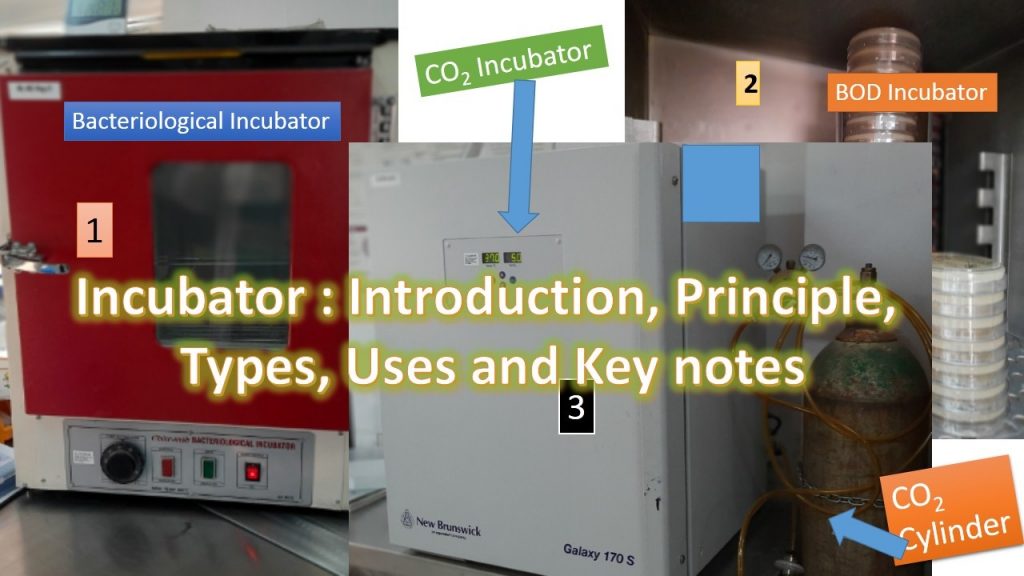
Introduction of Incubator
The incubator is an electrical device in which the incubation process is performed which conditions an enclosure to a predetermined temperature since it provides and maintains all artificial optimal conditions for the growth of microbial culture as well as cell and tissue culture.
Principle and working of incubators
Incubators work on the principle of thermo-electricity. It has a thermostat that maintains a constant temperature by creating a thermal gradient. When any conductor, an electrically-controlled switch used for switching an electrical power circuit subjects to a thermal gradient, it generates voltage called a thermoelectric effect. As power is supplied to the circuit predetermined temperature (37˚C) is set in the incubator. This temperature is maintained by the compatibility operation of the temperature sensor, temperature controller and temperature contactor are major components. When the power is off, current flows into the system thereby energizing the contactor that powers the bulbs which serve as heating elements to the system, the fan ensures the Distribution of hot air in the entire system. When the temperature in the system gets to desirable i.e. 37˚C the digital temperature controller sends an electrical signal to the contactor which de-energized thereby switching off the heaters temporarily. Also when the temperature reduces beyond the desired temperature. The contractor will be energized again thus switch on the system.
Types of incubators
The most common types of incubators are –
- BOD incubators
- Bacteriological incubators
- CO2 incubators
The main difference between these two types of incubators is due to temperature. BOD stands for biological oxygen demand and it is the amount of dissolved oxygen needed by aerobic biological organisms to break down organic materials present in a given sample at a certain temperature over a specific time period.
Bacteriological incubators
This type of incubator is used mainly in laboratories usually for the growth of bacteria. A constant temperature set according to the requirement is possible because of having a thermostat that maintains it. Accurate temperature can be visible on the thermometer fixed on incubators. Most of the incubators are programmable which do not need trial and error temperature settings. They only hold a heating system that maintains the temperature for the growth of bacteria. Due to the absence of a cooling system, these incubators are affected by the temperature of the surrounding environment.
BOD incubators (Low-Temperature Incubators)
These types of incubators are often called low-temperature incubators used for the growth of fungi i.e. yeast and mold as they require a low temperature to grow. These types of incubators are called BOD (Biological oxygen demand) incubators because in biological oxygen demand testing there is a need for a low temperature around 20-25˚C. So, don’t confuse the term because the purpose of BOD incubatorS is also the same as bacteriological incubators.
CO2 Incubators
Inside incubators, also known as a gassed incubators, an atmosphere is created that is as natural as possible to develop cell and tissue cultures. This way of cultivating living organisms is called in vitro and is the main application for CO2 incubators.
The following parameters are crucial for cell cultivation:
- CO2 level
- Temperature
- Humidity
Uses of incubators
Incubators use for the growth of microorganisms in many fields, including medical, pharmaceuticals, agricultural, environmental, food, and industrial microbiology, public health, basic research, and education. Whereas CO2 incubators are most frequently used in medical research and the pharmaceutical industry. However, they also provide sterile conditions for cultivation in other fields where cells must grow in a completely germ-free environment.
- CO2 incubators for tissue-engineered products
- CO2 incubators for in vitro fertilization
- CO2 incubators in diagnostics
- CO2 for developing biosensors
- CO2 incubators in cancer research
Keynotes on Incubator
- Calibration of incubators
Calibration is done by performing temperature monitoring by using a data logger with the sensor. - From what point is an incubator ready for use? In total, the incubator goes through three steps during validation: and they are-
- Installation Qualification
- Operational Qualifications and
- Performance Qualifications
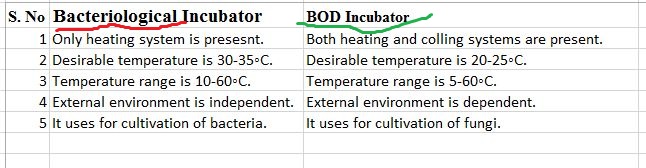
The difference between BOD and Bacteriological incubators are as follows-
# Equipment and instruments most commonly used in Microbiology#
The most common equipment and instruments used in microbiology are as follows-
- Bunsen burner
- Inoculating wire and loop
- Diamond pencil
- Microscope
- BOD Incubator
- CO2 incubator
- Automated autoclave
- Simple autoclave
- Hot air oven
- Refrigerator
- Deep freezer
- ELISA washer
- ELISA reader
- Electronic balance
- HOT plate
- Centrifuge
- Shaker
- Vortex mixer
- BD BACTEC
- PCR cabinet
- GeneXPERT (Real-time PCR) and
- Water bath as shown in the video-

Bibliography
- https://thermolabscientific.com/other-products/bod-incubator/
- https://thermolabscientific.com/other-products/bacteriological-incubato/
- http://bcas.du.ac.in/wp-content/uploads/2020/04/Incubators-are-used-for-the-growth-of-microorganisms-in-many.pdf
- https://pages.binder-world.com/en/co2-incubator-function
- https://www.fishersci.com/us/en/browse/90088090/co2-incubators