
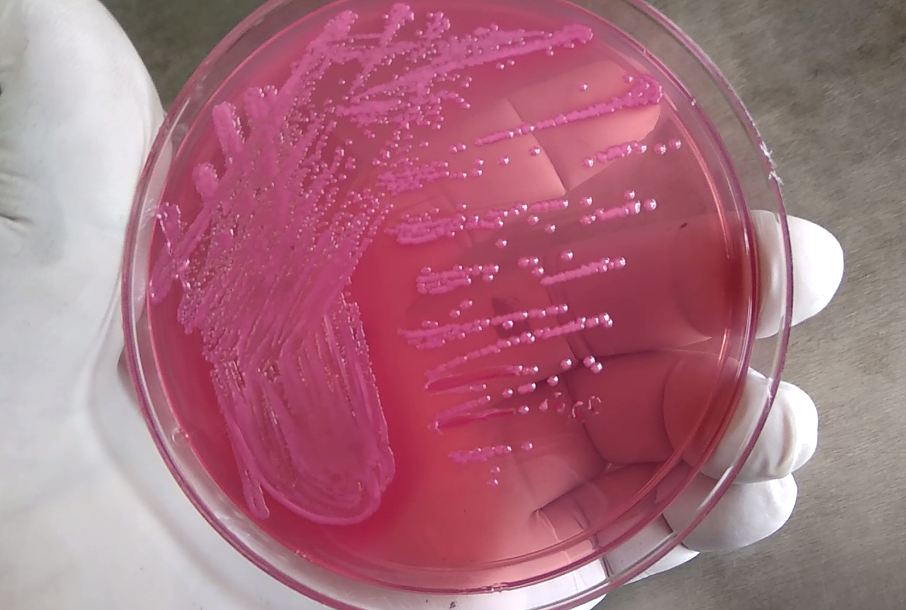
Enterobacteriaceae
The family Enterobacteriaceae is a very large group of gram-negative bacteria that possess a number of common morphological and biochemical properties and similar DNA base compositions. The widely used systems for the classification of Enterobacteriaceae are
- Bergey’s manual
- Kauffmann and
- Edward -Ewing.
Even having certain differences, the general approach is the same. A family is a group of subdivisions or tribes and each tribe consists of one or more genera. Similarly, each genus consists of one or more subgenera and species. The species are classified into types like biotypes, serotypes, bacteriophage types, and colicin types.
This family has the following tribes
Tribe 1: Escherichiae
Genus
- Escherichia
- Edwardsiella
- Citrobacter
- Salmonella
- Shigella
Tribe 2: Klebsiellae
Genus
- Klebsiella
- Enterobacter
- Hafnia
- Serratia
Tribe 3: Proteeae
Genus
- Proteus
- Morgenella
- Providencia
Tribe 4: Erwinieae
Genus
- Erwinia
Phenotypic features
The family Enterobacteriaceae has following general phenotypic features-
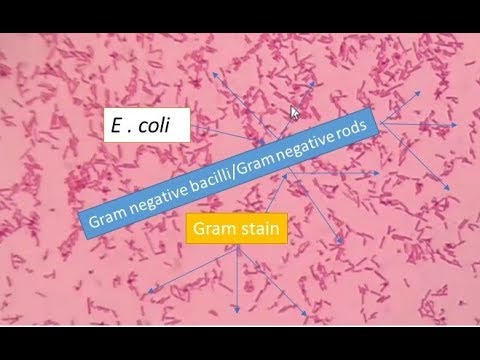
- They are small gram-negative rods.
- Having usual cell structure (non sporulated)
- Motile by peritrichous flagella.
- Grow on ordinary medium.
- Grow both aerobically and anaerobically.
- Grow without the addition of sodium chloride or other supplements.
- Grow well on MacConkey agar.
- Active biochemically.
- Ferments D-glucose and other sugar, often with gas production.
- Catalase test positive.
- Oxidase test negative.
- Reduce nitrate to nitrite
- Contain the enterobacterial common antigen (ECA) and
- They have a 39-59% guanine plus cytosine (G+C) content of DNA.
Key Notes
- All the members of the family Enterobacteriaceae are catalase-positive except Shigella dysentery type 1.
- All the members of the family Enterobacteriaceae are oxidase negative except Plesiomonas shigelloides which is oxidase test positive.
- All oxidase-positive bacteria are catalase test positive except Kingella, Eikenella, and Cardiobacterium those are catalase test negative.
# E. coli the member of Enterobacteriaceae on MacConkey agar, blood agar, and Chocolate agar as shown below-

#E. coli under microscope|| Gram stain ||Gram Negative bacilli or Gram-negative rods as shown below-
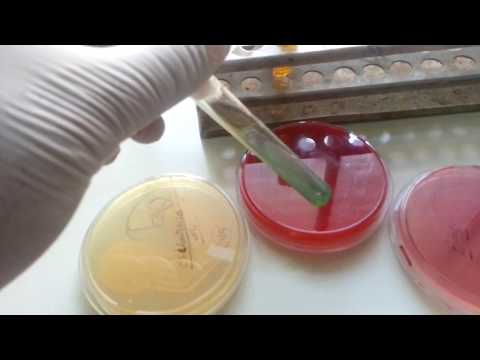
# Escherichia coli growth on nutrient agar, MacConkey agar, and Blood agar and also biochemical tests-
Triple Sugar Iron(TSI) agar
Sulphide Indole Motility (SIM) test
Citrate Utilization Test
Urea hydrolyzation Test as shown below
# Klebsiella pneumoniae growth on nutrient agar, MacConkey agar, and Blood agar and also biochemical tests-
Triple Sugar Iron(TSI) agar
Sulphide Indole Motility (SIM) test
Citrate Utilization Test
Urea hydrolyzation Test as shown below

# Swarming growth of Proteus on blood agar as shown below-

Salmonella Typhi isolated from Blood Culture-
Growth of Salmonella Typhi on nutrient agar, MacConkey agar, and blood agar
Growth of Salmonella in the blood culture bottle
Biochemical tests of Salmonella Typhi in
TSI
SIM
Citrate agar
Urea agar

Further Readings
- Cowan & Steel’s Manual for identification of Medical Bacteria. Editors: G.I. Barron & R.K. Felthani, 3rd ed 1993, Publisher Cambridge University press.
- Bailey & Scott’s Diagnostic Microbiology. Editors: Bettey A. Forbes, Daniel F. Sahm & Alice S. Weissfeld, 12th ed 2007, Publisher Elsevier.
- Clinical Microbiology Procedure Handbook, Chief in editor H.D. Isenberg, Albert Einstein College of Medicine, New York, Publisher ASM (American Society for Microbiology), Washington DC.
- Colour Atlas and Textbook of Diagnostic Microbiology. Editors: Koneman E.W., Allen D.D., Dowell V.R. Jr, and Sommers H.M.
- Jawetz, Melnick and Adelberg’s Medical Microbiology. Editors: Geo. F. Brook, Janet S. Butel & Stephen A. Morse, 21st ed 1998, Publisher Appleton & Lance, Co Stamford Connecticut.
- Mackie and Mc Cartney Practical Medical Microbiology. Editors: J.G. Colle, A.G. Fraser, B.P. Marmion, A. Simmous, 4th ed, Publisher Churchill Living Stone, New York, Melborne, Sans Franscisco 1996.
- Textbook of Diagnostic Microbiology. Editors: Connie R. Mahon, Donald G. Lehman & George Manuselis, 3rd edition2007, Publisher Elsevier.