
Introduction & Taxonomy
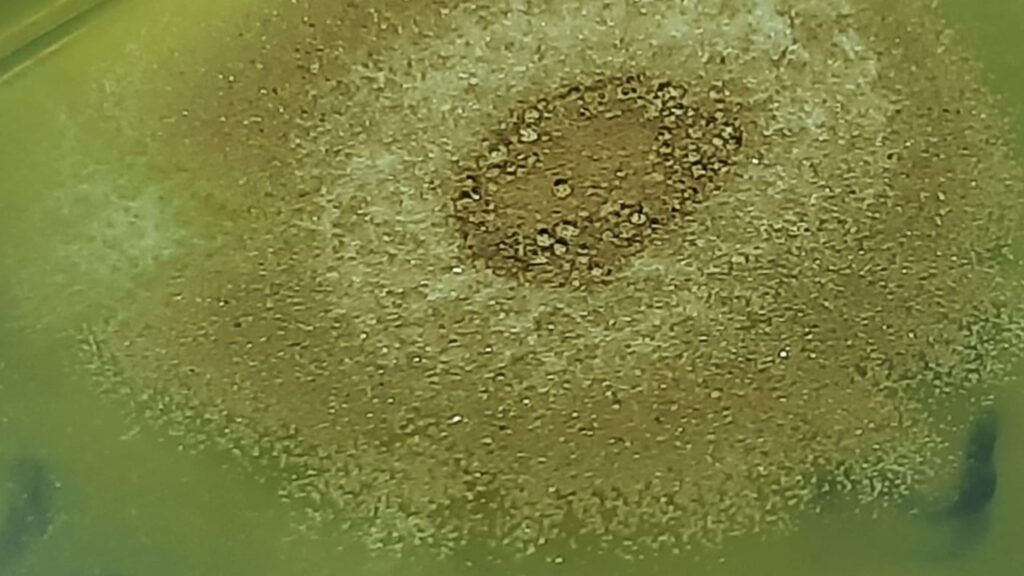
Aspergillus terreus is a filamentous fungus increasingly recognized as a significant emerging opportunistic pathogen. It is uniquely distinguished from other common species by its intrinsic resistance to amphotericin B, its characteristic cinnamon-brown colony color, and the production of specialized spores called aleurioconidia.
- Classification: Belongs to the phylum Ascomycota, section Terrei.
- Habitat: Ubiquitous saprobe found worldwide in soil, decomposing vegetation, compost, and stored grains, primarily in warmer tropical and subtropical regions.
- Economic Importance: Used industrially to produce lovastatin (a cholesterol-lowering drug), itaconic acid, and various enzymes.
Morphology
- Macroscopic: Colonies on Sabouraud agar are typically velvety and cinnamon-brown to sandy-beige. The reverse side often appears yellow to brown, sometimes with yellow soluble pigments.
- Microscopic:
- Conidial Heads: Compact, biseriate, and densely columnar.
- Conidiophores: Long, smooth-walled, and hyaline (clear).
- Conidia: Small (approx. 2 µm), globose, and smooth-walled.
- Aleurioconidia (Accessory Conidia): A unique feature produced directly on the vegetative hyphae. These are larger (6–7 µm) than standard spores and can induce elevated inflammatory responses.
Pathogenicity
- Spectrum of Disease: Causes a range of infections from superficial (e.g., onychomycosis, otomycosis) to life-threatening invasive aspergillosis (IA).
- Clinical Presentation:
- Systemic: Allergic bronchopulmonary aspergillosis (ABPA), aspergilloma, and disseminated aspergillosis.
- Dissemination: It has a higher propensity for hematogenous dissemination (spreading through the blood) to secondary organs like the brain, kidneys, and liver, especially in neutropenic patients.
- Virulence Factors: Includes the production of mycotoxins (e.g., terretonin, geodin, citrinin) and terrelysin, a hemolysin that lyses red blood cells to scavenge iron.
Lab Diagnosis
- Culture: Dependable identification relies on culture morphology (cinnamon colonies) and microscopic inspection (columnar heads).
- Microscopy: Direct examination using KOH or Calcofluor White reveals septate hyphae branching at 45-degree angles.
- Biomarkers: Galactomannan (GM) antigen and (1→3)-β-D-glucan detection in serum or bronchoalveolar lavage (BAL) fluid are used, though GM sensitivity can vary.
- Molecular: PCR and Next-Generation Sequencing (NGS) provide rapid, species-level identification directly from clinical specimens.
Treatment & Prevention
- Drug of Choice: Voriconazole or Isavuconazole is typically preferred due to the organism’s intrinsic resistance to amphotericin B.
- Resistance: Amphotericin B failure is a hallmark of this species, leading to higher mortality rates (often >80% in invasive cases) compared to other Aspergillus species.
- Prevention:
- Environmental: Use of HEPA filtration in hospital wards and avoiding construction-related dust exposure.
- Reservoir Control: Eliminating indoor reservoirs, such as potted plants, from the rooms of immunocompromised patients.
Keynotes
- “Cinnamon” Fungus: Known for its sandy-brown colony color.
- Intrinsic Polyene Resistance: It is naturally resistant to amphotericin B.
- Wait-and-Watch Role: Conidia can persist long-term within alveolar macrophages, potentially germinating when the host’s immune system further weakens.
- Environmental Versatility: Capable of decomposing complex materials, including polypropylene plastic.
Further Readings
- https://pmc.ncbi.nlm.nih.gov/articles/PMC8404697
- https://en.wikipedia.org/wiki/Aspergillus_terreus
- https://www.sciencedirect.com/science/article/pii/S2666517424000026
- https://www.academia.edu/129603916/Emergence_of_Aspergillus_terreus_as_a_Notable_Fungal_Pathogen_of_Human_and_Animal_Health
- https://www.sciencedirect.com/science/article/pii/S221425092500157X
- https://www.dovepress.com/invasive-aspergillus-terreus-morphological-transitions-and-immunoadapt-peer-reviewed-fulltext-article-IDR
- https://patents.google.com/patent/US20140221504A1/en
- https://www.creative-biolabs.com/drug-discovery/therapeutics/aspergillus-terreus.htm
- https://pmc.ncbi.nlm.nih.gov/articles/PMC3820361/
- https://www.sciencedirect.com/science/article/abs/pii/S0924857914002325