
Introduction
The Acinetobacter baumannii complex (ABC) is a group of highly resilient, opportunistic Gram-negative bacteria that pose a critical threat in healthcare settings. Classified as an “ESKAPE” pathogen, it is a leading cause of severe hospital-acquired (nosocomial) infections. The World Health Organization (WHO) categorizes carbapenem-resistant Acinetobacter baumannii (CRAB) in the highest “critical priority” tier for the development of new antibiotics.
Species in this Group
Because these species are genetically distinct but phenotypically almost identical, standard diagnostic laboratories group them into the Acinetobacter calcoaceticus-baumannii (ACB) complex. The complex primarily comprises:
- Acinetobacter baumannii: The principal pathogenic species, responsible for up to 80% of human clinical infections.
- Acinetobacter nosocomialis: Frequently isolated from hospital environments and clinical specimens.
- Acinetobacter pittii: Clinically important and capable of gathering significant antibiotic resistance profiles.
- Acinetobacter calcoaceticus: Typically a non-pathogenic environmental organism found in soil and water, rarely causing human disease.
- Acinetobacter seifertii & Acinetobacter dijkshoorniae: More recently recognized human clinical isolates included in the broader complex.
Morphology & Cultural Characteristics
- Microscopic Appearance: Gram-negative coccobacilli. They appear as short, plump rods, often arranged in pairs or short chains.
- Staining Pitfall: They frequently resist decolorization during standard Gram staining, meaning they can masquerade as Gram-positive diplococci (resembling Streptococcus pneumoniae) in direct blood cultures.
- Motility: Mechanically non-motile (lacks flagella). However, it exhibits a distinct, surface-dependent jerky movement known as twitching motility using pili.
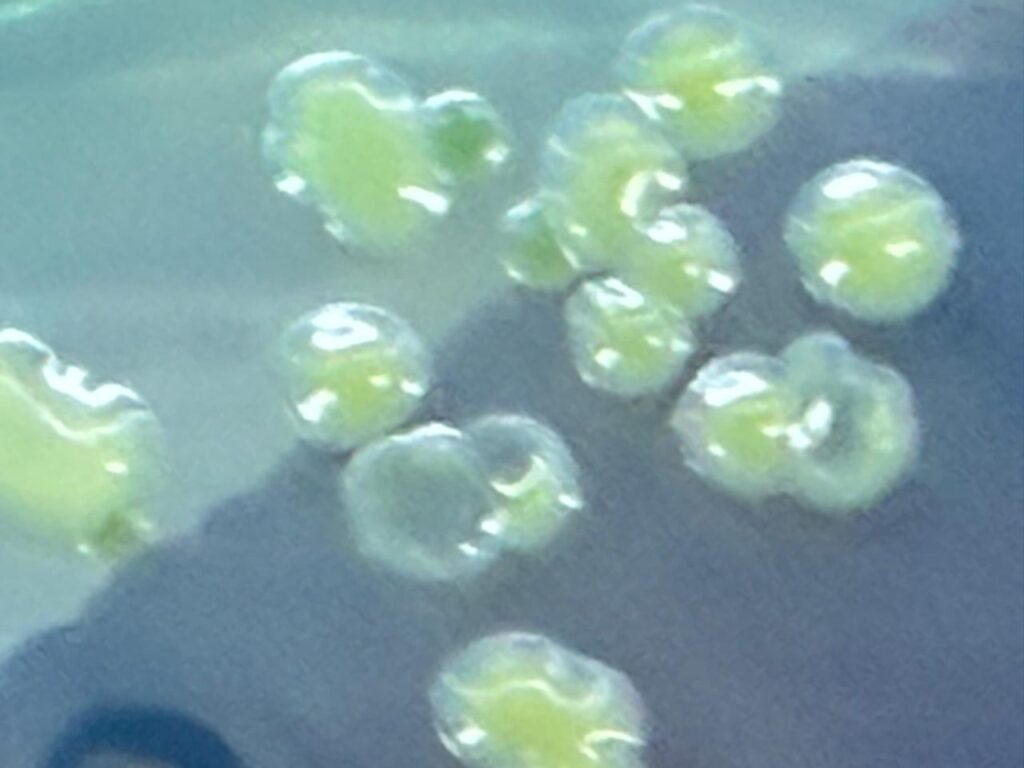
- Atmospheric & Growth Requirements: Strict aerobe. It grows easily on standard media like blood agar (where it is non-hemolytic) and MacConkey agar (appearing as a non-lactose fermenter, sometimes with a faint pinkish tint). It is uniquely thermotolerant, growing optimally at 37°C but surviving up to 44°C.
Pathogenicity & Virulence Factors
The A. baumannii complex targets critically ill, immunocompromised patients, particularly those in Intensive Care Units (ICUs) with invasive medical devices.
Virulence Factors
- Biofilm Formation: Easily attaches to abiotic surfaces like plastic ventilators, endotracheal tubes, and catheters, shielding the bacteria from both antibiotics and desiccation.
- Outer Membrane Proteins (OmpA): Key porin that triggers host cell apoptosis and interacts with human epithelial cells.
- Capsular Polysaccharide: Protects the bacterium against complement-mediated killing and phagocytosis.
- Siderophores: High-affinity iron acquisition systems (e.g., acinetobactin) that allow the pathogen to scavenge iron from host tissues.
Clinical Manifestations
- Ventilator-Associated Pneumonia (VAP): The most frequent clinical manifestation.
- Bloodstream Infections (Bacteremia/Septic Shock): Often linked to central venous catheters.
- Surgical Site & Soft Tissue Infections: Severe wound contamination.
- Post-Neurosurgical Meningitis: Associated with invasive external ventricular drains.
Laboratory Diagnosis
Diagnosing an ABC infection involves separating true infection from simple skin or respiratory colonization.
Clinical specimens like Sputum, Blood, Wound Swab
──> Gram Stain ───> Gram-negative coccobacilli (often in pairs)
──> Culture (Blood Agar / MacConkey / CHROMagar)
──> Biochemical Testing: Oxidase (-) / Catalase (+) / Growth at 44°C
──> Speciation (MALDI-TOF, rpoB / 16S rRNA Sequencing)
- Biochemical Profile: Oxidase-negative, catalase-positive, indole-negative, and non-lactose fermenting.
- Selective Media: Specialized chromogenic agars (like CHROMagar Acinetobacter) are heavily utilized for active hospital surveillance, producing distinct salmon-pink colonies.
- Automated Systems & Speciation: While commercial phenotypic panels (VITEK-2, MicroScan) report isolates broadly as A. baumannii complex, specific sub-species differentiation requires MALDI-TOF Mass Spectrometry or molecular sequencing (16S rRNA or rpoB gene).
Treatment Guidelines
Treating ABC is uniquely difficult because the pathogen utilizes beta-lactamases, aminoglycoside-modifying enzymes, and active efflux pumps to neutralize drugs.
- Susceptible Isolates: Standard treatment utilizes high-dose Ampicillin-sulbactam (the sulbactam component has direct, intrinsic bactericidal activity against Acinetobacter), anti-pseudomonal carbapenems (Meropenem or Imipenem), or Cefepime.
- Carbapenem-Resistant (CRAB) Regimens: According to modern Sanford Guide Recommendations and IDSA Guidelines, targeted therapies require combination options:
- Preferred Combo: Sulbactam-durlobactam (a novel beta-lactamase inhibitor combination built specifically for CRAB) administered alongside a carbapenem.
- Alternative Combo: High-dose Ampicillin-sulbactam + Meropenem + a polymyxin agent (such as Polymyxin B or Colistin).
- Salvage Agents: Cefiderocol (a novel siderophore cephalosporin) or Minocycline/Tigecycline, though cefiderocol is typically reserved for cases where other options have failed.
Prevention & Control
Because ABC can survive on dry plastic and steel surfaces for weeks, strict infection control is critical:
- Hand Hygiene: Strict adherence to alcohol-based hand rubs or washing before and after contact with patients or their immediate environments.
- Contact Isolation: Isolating colonized or infected patients in private rooms, mandating gowns and gloves for all entering personnel.
- Environmental Disinfection: Dedicated daily cleaning of high-touch medical equipment (ventilators, bed rails) with EPA-registered sporicidal or specialized chemical disinfectants capable of penetrating biofilms.
- Antimicrobial Stewardship: Limiting the empirical, over-prescribed use of broad-spectrum carbapenems to decrease selective pressure.
Keynotes
- “Iraqibacter”: Earned this colloquial moniker due to its high incidence in military personnel sustaining complex blast wounds during operations in Iraq and Afghanistan.
- Colonization vs. Infection: The bacteria easily colonize open wounds or respiratory tracts without causing disease. Treatment should only be initiated for clear, deteriorating clinical infections, not asymptomatic colonization.
- Intrinsic Resistance: Possesses a natural, chromosome-encoded AmpC beta-lactamase and highly active efflux pumps that routinely defeat standard cephalosporins.
Further Readings
- https://pmc.ncbi.nlm.nih.gov/articles/PMC3442836/
- https://www.cdc.gov/acinetobacter/about/index.html
- https://web.sanfordguide.com/e1f1b28667ed4739a3c5cd85dc24f64f
- https://www.sciencedirect.com/topics/medicine-and-dentistry/acinetobacter-calcoaceticus-baumannii-complex
- https://pmc.ncbi.nlm.nih.gov/articles/PMC7593844/
- https://pmc.ncbi.nlm.nih.gov/articles/PMC8003822/
- https://gardp.org/stories/meet-acinetobacter-baumannii/
- https://pmc.ncbi.nlm.nih.gov/articles/PMC4266826/
- https://enviromicro-journals.onlinelibrary.wiley.com/doi/10.1111/jam.15130